
The private equity and alternative investment industries stand at the precipice of their most significant expansion opportunity in decades. With the Trump administration poised to issue an executive order opening 401(k) retirement plans to private market investments, the $12.4 trillion defined contribution market represents an unprecedented structural tailwind for alternative asset managers. This comprehensive analysis examines the regulatory evolution, market dynamics, and transformative implications of integrating private markets into America’s retirement infrastructure.
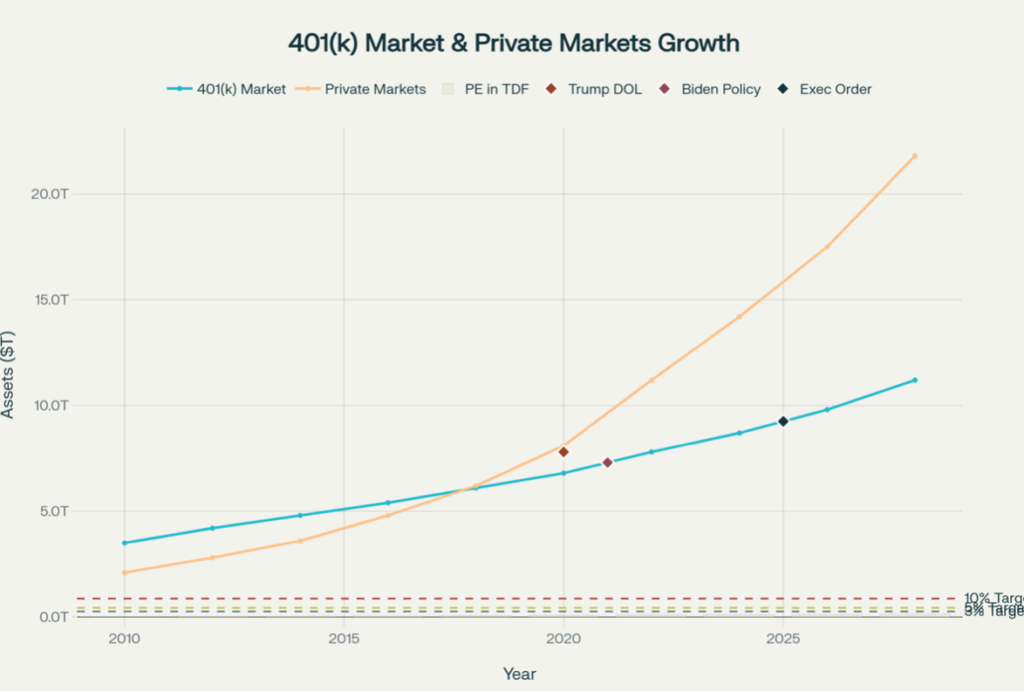
Currently, private equity and alternative investments maintain minimal penetration in defined contribution plans, with only $115 billion of the $3.5 trillion target-date fund market allocated to private assets. However, even conservative allocation scenarios of 3-5% could inject $400-600 billion into private markets, fundamentally reshaping the industry’s capital formation landscape and democratizing access to historically exclusive investment strategies.
401(k) Market Size vs Private Markets Growth and Penetration Opportunity
Historical Context and Legislative Evolution
The Employee Retirement Income Security Act (ERISA) of 1974 established stringent fiduciary standards that effectively excluded private market investments from defined contribution plans. For nearly five decades, these regulations confined alternative investments to sophisticated institutional investors and ultra-high-net-worth individuals, creating a bifurcated investment ecosystem where ordinary retirement savers remained locked out of potentially higher-returning asset classes.
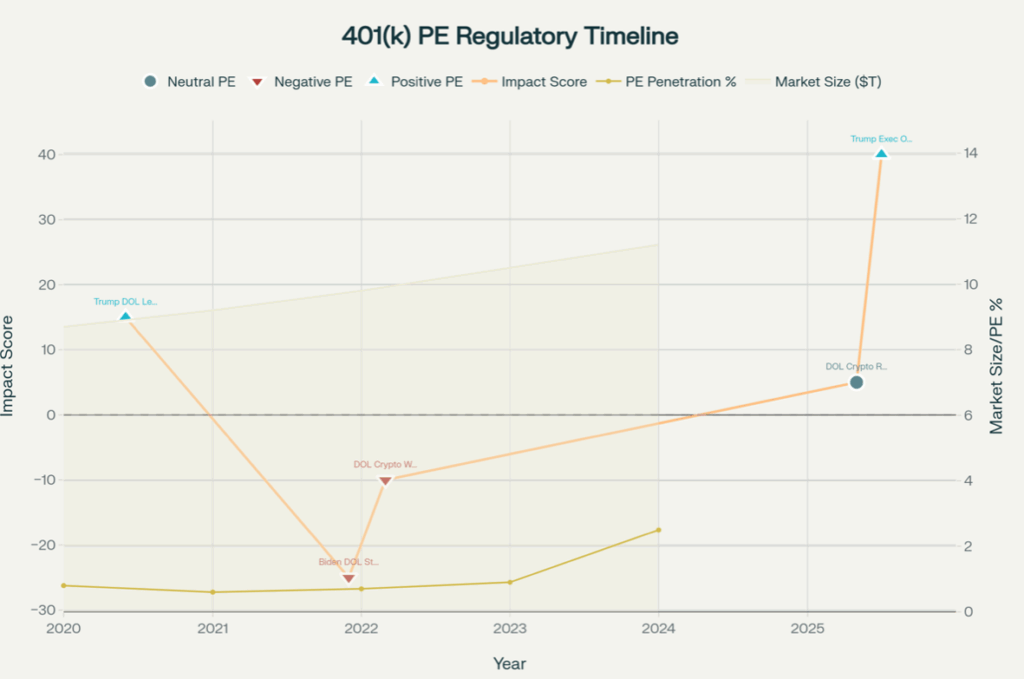
The regulatory landscape began shifting during the Trump administration’s first term, when the Department of Labor issued a groundbreaking June 2020 Information Letter. This guidance represented the first formal acknowledgment that private equity investments could be prudently included in professionally managed asset allocation funds, provided fiduciaries conducted appropriate due diligence and limited allocations to reasonable percentages.
The Biden Reversal and Market Uncertainty
The Biden administration’s December 2021 Supplemental Statement marked a significant policy reversal, emphasizing caution and highlighting the risks associated with private equity investments in retirement plans. This guidance created regulatory uncertainty that effectively stalled industry momentum, with many plan sponsors adopting a wait-and-see approach despite the absence of explicit prohibitions.
The administration’s subsequent actions, including warnings against cryptocurrency investments in 2022 and the recent rescission of those warnings in May 2025, demonstrated the politically sensitive nature of retirement plan investment policy. These regulatory oscillations underscored the need for clearer, more durable guidance that could withstand political transitions.
Regulatory Timeline: Private Markets Access to 401(k) Plans (2020-2025)
The Expected Executive Order: A Paradigm Shift
Industry sources anticipate that the Trump administration’s forthcoming executive order will direct the Department of Labor and Securities and Exchange Commission to develop comprehensive guidance facilitating private market access in 401(k) plans. This directive is expected to address key structural barriers, including:
The Scale of the Prize
The American defined contribution market represents one of the world’s largest pools of investable capital, with total assets of $12.2 trillion across all employer-sponsored plans and $8.7 trillion specifically in 401(k) accounts. This market has experienced consistent growth, expanding from approximately $3.5 trillion in 2010 to current levels, driven by automatic enrollment features, increased contribution limits, and strong equity market performance.
Target-date funds, which serve as the default investment option for 68% of plan participants and control 38% of total 401(k) assets, represent the most logical entry point for private market integration. These professionally managed, lifecycle-based portfolios already incorporate sophisticated asset allocation strategies and could seamlessly integrate alternative investments without requiring individual participant selection.
Performance Advantages and Return Enhancement
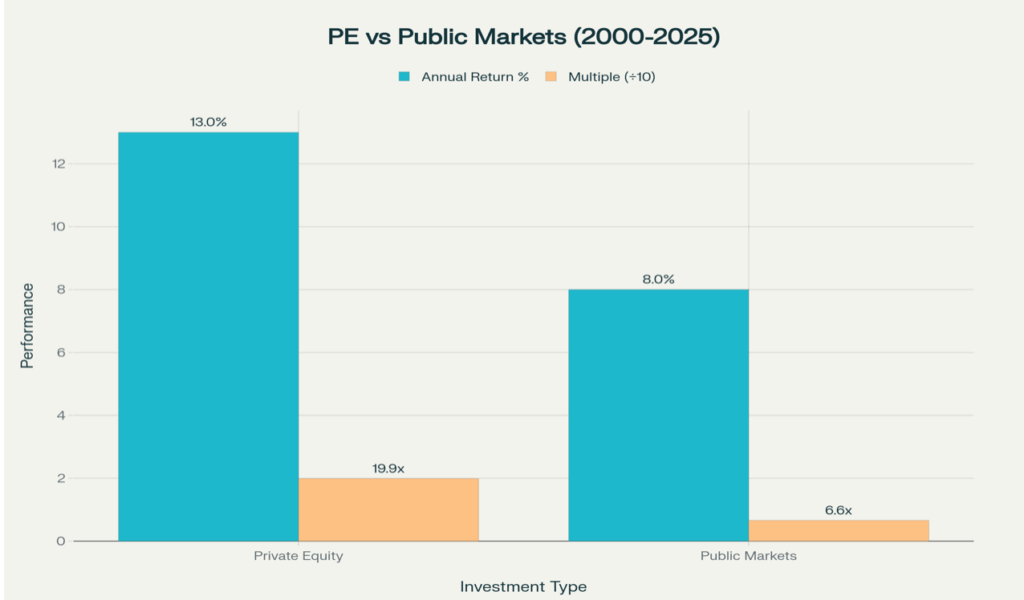
Private equity’s historical outperformance relative to public markets provides compelling justification for inclusion in retirement portfolios. Over the past 25 years, private equity has generated net annualized returns of 13% compared to 8% for public markets, translating to a multiple of capital of 19.9x versus 6.6x for traditional investments.
Private Equity vs Public Markets: 25-Year Performance Comparison
This performance differential, while subject to cyclical variations, reflects private equity’s structural advantages:
Research by leading asset managers suggests that modest private equity allocations (5-10%) in target-date funds could increase annual returns by 50-90 basis points, potentially generating 15-20% more retirement wealth over a 40-year career.
The Alternative Asset Management Opportunity
The private equity and alternative investment industry has evolved dramatically over the past decade, with total global assets under management reaching $14.2 trillion. Leading firms have experienced unprecedented growth:
These firms have invested heavily in product innovation, developing semi-liquid fund structures, evergreen vehicles, and collective investment trusts specifically designed for defined contribution plan integration. The democratization of private markets represents a natural evolution of their business models, potentially doubling their addressable market.
Technological Innovation and Operational Solutions
The integration of private markets into 401(k) plans requires sophisticated technological infrastructure to address traditional barriers:
Liquidity Management: Advanced cash flow modeling and secondary market access to provide participant liquidity while maintaining private market exposure
Valuation and Reporting: Real-time portfolio valuation systems and transparent performance reporting aligned with daily-valued retirement plan requirements
Risk Management: Sophisticated stress testing and scenario analysis to ensure portfolio resilience across market cycles
Participant Communication: Digital platforms providing education, performance tracking, and suitability assessment tools
America’s Retirement Crisis: Scale and Urgency
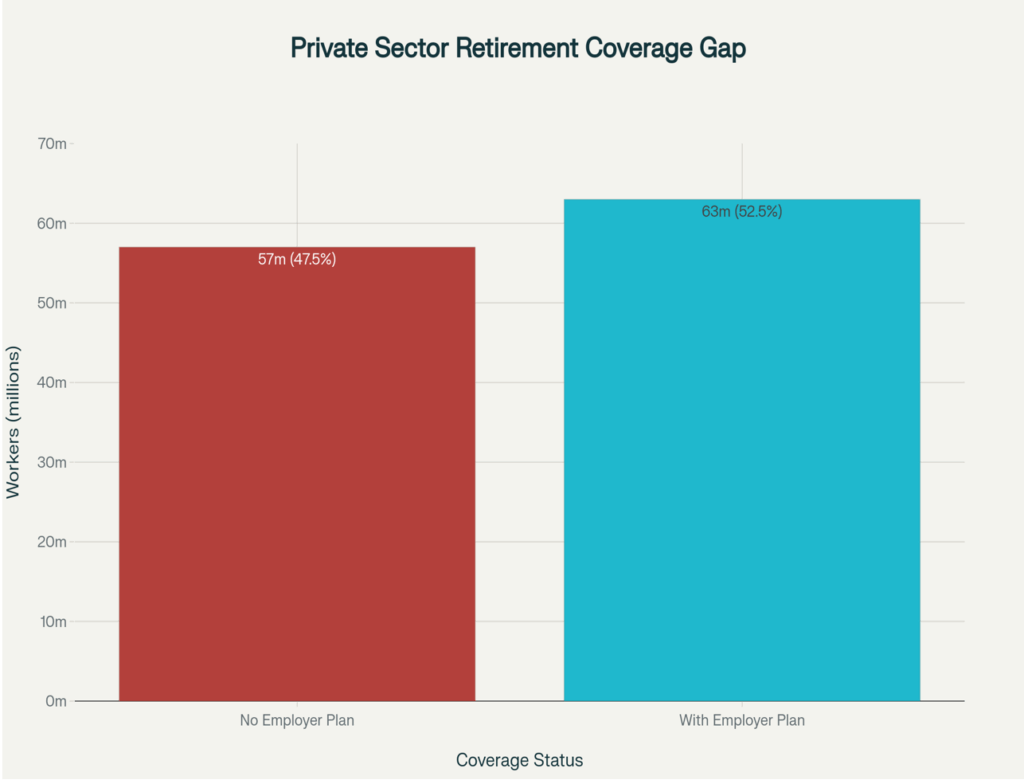
The United States faces a mounting retirement security crisis that provides additional impetus for private market integration. Current statistics reveal concerning trends:
US Retirement Savings Crisis and Private Markets Solution Potential
Private market integration offers a potential solution to these retirement security challenges through enhanced return generation. Conservative estimates suggest that additional annual returns of 50-100 basis points could reduce required savings rates by 1.5-2.0 percentage points, making retirement goals more attainable for middle-class Americans.
This democratization of private markets could help address the “investment apartheid” that has historically limited ordinary savers to lower-returning public market investments while institutional investors and the ultra-wealthy accessed higher-performing alternatives.
International Precedents and Best Practices
Several developed markets have successfully integrated private markets into their retirement systems, providing instructive precedents:
Australia: The superannuation system allocates approximately 25% of assets to alternative investments, including private equity, infrastructure, and real estate. This diversified approach has contributed to superior long-term performance and enhanced retirement outcomes.
Canada: The Canada Pension Plan Investment Board and other public pension funds maintain significant private market allocations, generating returns that support system sustainability and benefit adequacy.
United Kingdom: Defined contribution pension schemes are increasingly incorporating private market investments through pooled investment vehicles and master trusts, with regulatory support for innovation.
These international examples demonstrate that well-structured private market integration can enhance retirement security while maintaining appropriate risk management and participant protections.
Fiduciary Considerations and Litigation Risk
The integration of private markets into 401(k) plans occurs against a backdrop of heightened ERISA litigation, with 136 new class action cases filed in 2024 compared to previous years. Key litigation themes include:
Successful private market integration will require robust fiduciary frameworks addressing these litigation risks through:
Structural and Operational Hurdles
Private market integration faces several operational challenges that must be addressed:
Liquidity Management: Balancing illiquid private market investments with daily liquidity requirements in 401(k) plans
Valuation Complexity: Establishing fair value methodologies for privately held investments in daily-valued accounts
Capacity Constraints: Managing asset allocation across potentially millions of small accounts while maintaining investment efficiency
Regulatory Compliance: Ensuring adherence to complex ERISA requirements while accommodating private market investment structures
Capital Formation and Market Structure
The integration of private markets into 401(k) plans could fundamentally alter global capital formation patterns. Conservative estimates suggest that 3-5% allocations could generate $400-600 billion in new private market capital over the next decade, representing:
Technological Innovation and Digital Transformation
The retirement plan industry is experiencing rapid technological advancement that could facilitate private market integration:
Artificial Intelligence: Advanced portfolio optimization and risk management systems
Blockchain Technology: Enhanced transparency and efficiency in private market transactions
Digital Platforms: Improved participant engagement and education tools
Data Analytics: Sophisticated performance measurement and reporting capabilities
These technological developments could address traditional barriers to private market access while enhancing participant outcomes and operational efficiency.
Regulatory Evolution and Policy Implications
The expected executive order represents the beginning of a broader regulatory transformation that could include:
Legislative Initiatives: Congressional action to codify private market access and provide permanent regulatory clarity
International Coordination: Harmonization of regulatory approaches across developed markets to facilitate cross-border investment
Innovation Sandboxes: Regulatory frameworks allowing controlled experimentation with new investment structures and participant protections
Systemic Risk Oversight: Enhanced monitoring of private market concentration and potential impacts on financial stability
Wealth Distribution and Social Equity
The democratization of private markets could have profound implications for wealth distribution and social mobility. Historically, the “alternative investment premium” has been captured primarily by institutional investors and ultra-high-net-worth individuals, contributing to wealth concentration. Broader access through retirement plans could:
Systemic Risks and Regulatory Considerations
The integration of private markets into retirement plans also raises important systemic risk considerations:
Market Concentration: Potential concentration of private market assets among a limited number of large asset managers
Liquidity Risks: Challenges in managing participant withdrawals during market stress periods
Valuation Concerns: Potential for asset mispricing in illiquid private market investments
Regulatory Arbitrage: Risk of regulatory gaps between private and public market oversight
The potential integration of private markets into America’s 401(k) system represents one of the most significant structural shifts in retirement planning since the introduction of defined contribution plans in the 1980s. This transformation could unlock substantial value for retirement savers while providing alternative asset managers with unprecedented access to the world’s largest pool of retirement capital.
The convergence of regulatory reform, technological innovation, and demographic pressure creates a unique opportunity to address America’s retirement security crisis while democratizing access to historically exclusive investment strategies. Success will require careful implementation that balances return enhancement with appropriate risk management and participant protections.
For alternative asset managers, this represents a generational opportunity to expand their market reach and diversify their investor base. For retirement savers, it offers the potential for enhanced returns and improved retirement outcomes. For policymakers, it provides a tool to address mounting retirement security challenges while promoting economic growth and innovation.
The path forward requires continued collaboration among industry participants, regulatory authorities, and retirement plan stakeholders to ensure that private market integration serves the broader goal of retirement security for all Americans. The stakes are high, but the potential benefits—for individual savers, the financial services industry, and the broader economy—justify the effort required to realize this transformative opportunity.
The great convergence of private markets and retirement planning is not merely a regulatory change; it is a fundamental restructuring of how Americans save for retirement and how capital is allocated across the economy. The implications will reverberate for decades, shaping the financial security of millions of Americans and the structure of global capital markets.
This analysis is part of the South Sigma Insights series, providing comprehensive research and strategic analysis for Accredited Investors.
South Sigma Consulting FZCO (“South Sigma”) is an independent investment research and advisory firm providing consulting services to advisory groups, family offices, and institutional investors. Our services include manager sourcing, strategy due diligence, and portfolio design, with a focus on alternative investments such as hedge funds, private markets, real assets, and infrastructure. The information provided by South Sigma is intended solely for sophisticated and professional investors and is for informational and discussion purposes only. It is not intended for retail investors or the general public. South Sigma does not provide financial product advice, nor does it offer, promote, or distribute specific investment products or securities. All research, opinions, and assessments are provided on a non-reliance basis and should not be interpreted as a recommendation to invest, hold, or divest from any particular fund, manager, or strategy. Users are solely responsible for verifying the information provided and conducting their own due diligence. Investment decisions should be made based on independent judgment and, where appropriate, in consultation with qualified financial, legal, and tax advisors. While South Sigma strives to ensure the accuracy and reliability of the information it provides, no warranty or representation is made as to its completeness, accuracy, or fitness for any particular purpose. The information is provided “as is,” and South Sigma disclaims all warranties, express or implied, including but not limited to warranties of merchantability and fitness for a particular purpose. South Sigma does not act as a fiduciary or agent for any party and accepts no liability for any loss arising directly or indirectly from the use of information provided in the course of its consulting services. The information is not a substitute for professional advice. All content is confidential and proprietary to South Sigma Consulting FZCO. It may not be reproduced, distributed, or published without prior written consent from South Sigma.
For inquiries, please contact info@southsigma.com.
Accept Cancel