
Life settlement funds represent a compelling alternative investment opportunity that has gained significant institutional acceptance due to their unique risk-return characteristics and portfolio diversification benefits. This comprehensive analysis examines life settlements as an asset class, providing investors with essential insights into performance metrics, risk factors, valuation methodologies, and strategic portfolio integration considerations.
Definition and Market Fundamentals
A life settlement is a financial transaction in which the owner of a life insurance policy sells the policy to a third-party investor for a lump sum payment that exceeds the cash surrender value but is less than the death benefit. The investor assumes responsibility for future premium payments and ultimately receives the death benefit upon the insured’s death, creating an investment vehicle fundamentally driven by mortality rather than financial market dynamics.
The life settlement market has demonstrated remarkable resilience and growth, with market participants noting the asset class’s unique value proposition of providing returns uncorrelated to traditional financial markets. Recent market data indicates that American seniors who sold their policies in the secondary market received more than six and a half times the cash surrender value, highlighting the significant value creation for both policyholders and investors.
Market Size and Transaction Dynamics
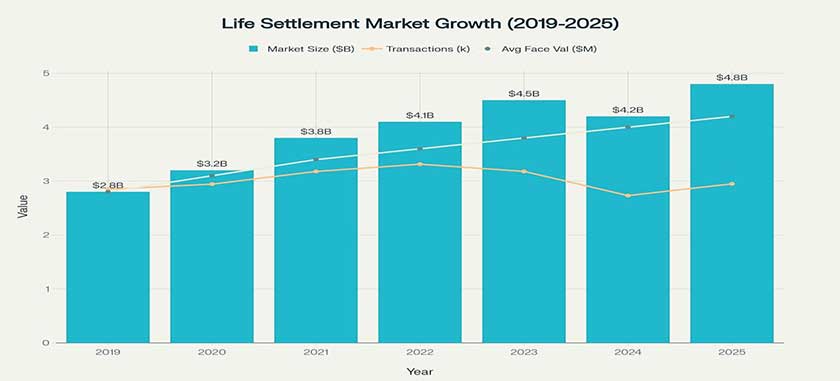
The U.S. life settlement market has evolved into a substantial alternative investment sector, with transaction volumes fluctuating between $2.8 billion and $4.8 billion annually over the past seven years.
The market experienced a temporary contraction in 2024, with transaction counts declining to 2,732 from 3,181 in the previous year, primarily due to macroeconomic factors and interest rate environments.
Life settlement market growth showing market size expansion and transaction volume trends
Despite short-term volatility, the underlying fundamentals remain robust, supported by demographic trends including an aging population with substantial life insurance coverage and increasing institutional acceptance of the asset class. The average face value of policies has steadily increased from $2.8 million in 2019 to $4.2 million in 2025, reflecting both inflation and the market’s focus on larger, more efficient transactions.
Return Characteristics and Volatility Metrics
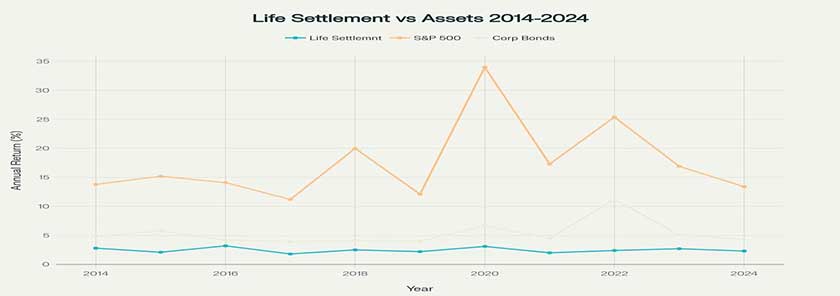
Life settlements have delivered exceptional risk-adjusted returns over the past decade, with average annual returns ranging from 8.7% to 11.2% between 2014 and 2024.
The asset class has demonstrated remarkable consistency, maintaining low volatility typically between 1.8% and 3.2%, significantly lower than traditional equity and fixed income investments.
Historical performance comparison showing life settlements’ consistent returns and low volatility versus traditional asset classes
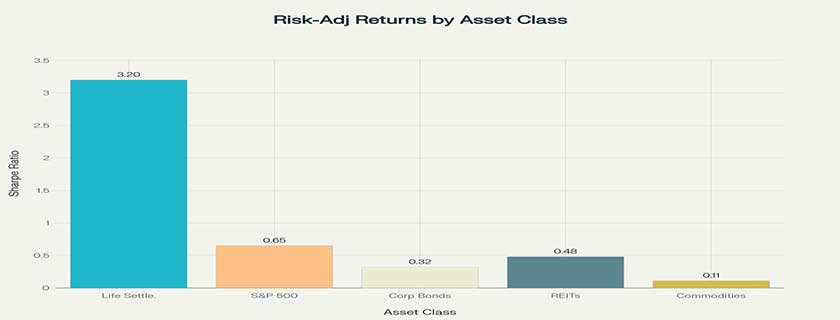
The superior risk-adjusted performance is evidenced by Sharpe ratios exceeding 3.0, substantially outperforming equity markets (0.65), corporate bonds (0.32), and other alternative investments. Academic research analyzing over 9,000 policies with aggregate death benefits exceeding $24 billion has validated these performance characteristics, demonstrating expected returns averaging 12.5% annually.
Performance Dashboard Analysis
Comprehensive performance analysis across multiple metrics reveals life settlements’ compelling investment profile when compared to traditional asset classes.
Comprehensive performance dashboard comparing life settlements with traditional asset classes across multiple risk-return metrics
The asset class has achieved average annual returns of 9.6% with volatility of only 2.4%, resulting in a Sharpe ratio of 3.2 that significantly exceeds all major asset classes including equities, bonds, REITs, and commodities.
This exceptional risk-adjusted performance stems from the fundamental driver of returns – human mortality – which operates independently of economic cycles, interest rate movements, and market sentiment. Even in scenarios where life expectancy estimates prove conservative by three years, investors can still expect positive annual returns of 3.2%.
Primary Risk Categories and Impact Analysis
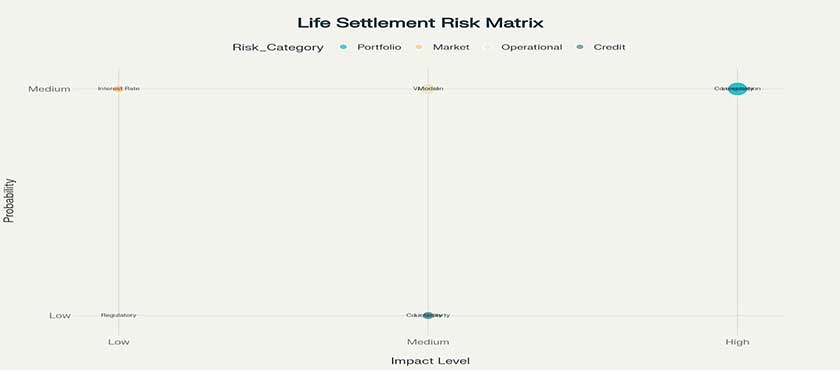
Life settlement investments face distinct risk factors that differ significantly from traditional asset classes, requiring specialized risk management approaches. The most significant risks include longevity risk, valuation risk, liquidity risk, and counterparty risk, each requiring specific mitigation strategies.
Risk assessment matrix showing impact and probability of various life settlement investment risks
Longevity risk represents the primary concern, as insureds living longer than expected delays the collection of death benefits. This risk can be effectively managed through portfolio diversification across different life expectancies, health conditions, and demographic profiles, with optimal diversification typically achieved at approximately 300 policies.
Risk Mitigation Framework and Best Practices
Professional life settlement managers employ sophisticated risk mitigation strategies including multiple independent life expectancy assessments from reputable medical underwriting firms such as AVS, 21st Services, and FASANO.
Geographic and demographic diversification across age groups, policy sizes, and health conditions further reduces concentration risk while maintaining return potential.
The regulatory environment provides additional investor protection, with most states implementing comprehensive oversight of life settlement transactions. State regulations typically require licensing of providers, mandatory rescission periods ranging from 15-30 days, and extensive disclosure requirements that enhance market transparency and consumer protection.
Diversification Advantages and Correlation Analysis
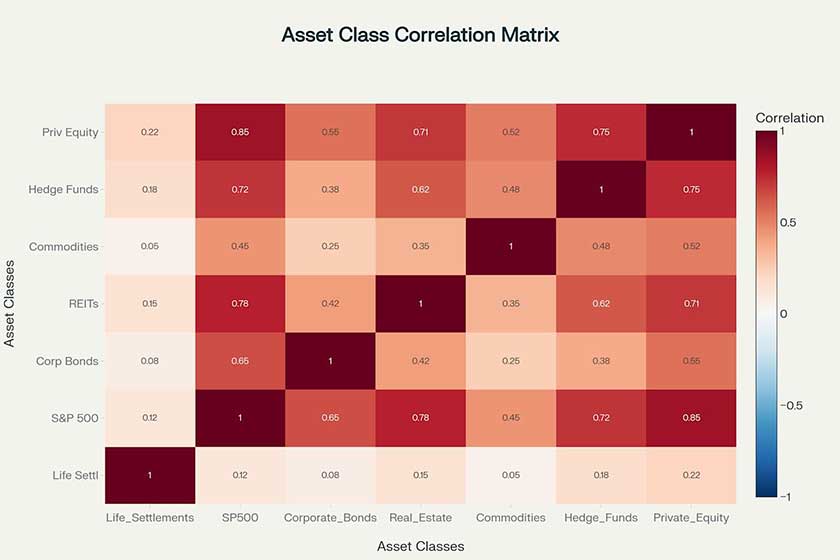
One of the most compelling attributes of life settlements is their exceptionally low correlation with traditional financial markets.
Correlation analysis reveals that life settlements maintain correlations of 0.12 or lower with major asset classes, making them an ideal diversification tool for institutional portfolios.
Correlation matrix demonstrating life settlements’ low correlation with traditional asset classes
This low correlation stems from the fundamental driver of returns – human mortality – which operates independently of economic cycles, interest rate movements, and market sentiment. Research indicates that life settlements have historically provided portfolio benefits during periods of market stress when traditional correlations tend to increase.
Strategic Allocation Recommendations
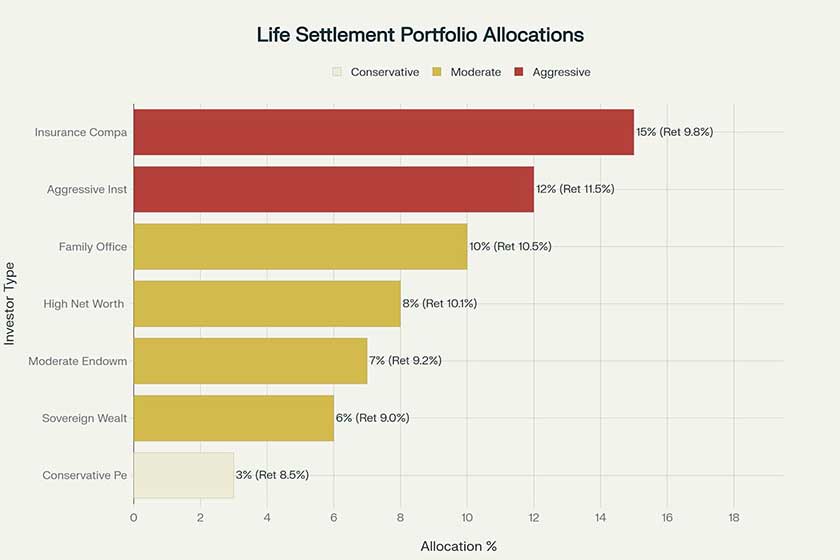
Portfolio allocation to life settlements varies significantly based on investor type, risk tolerance, and investment objectives.
Conservative pension funds typically allocate 3% for stability and diversification, while growth-oriented institutions may allocate up to 12% to capture enhanced returns.
Recommended life settlement allocation percentages across different investor types and risk profiles
Insurance companies represent natural investors in this space, often allocating 15% or more as a hedge against their longevity exposure. The incorporation of life settlements into balanced portfolios demonstrates clear risk-reduction benefits, with studies showing portfolios including life settlements experience reduced volatility while maintaining competitive returns.
Comprehensive Transaction Workflow
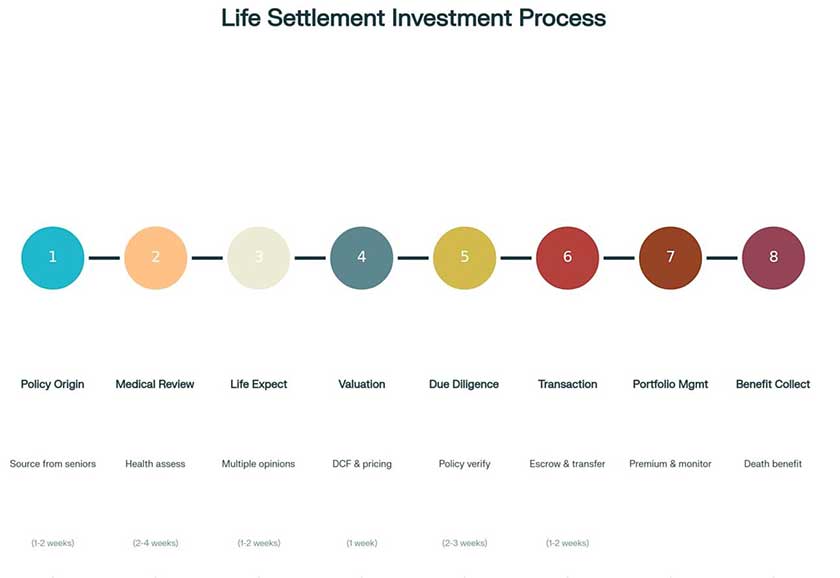
The life settlement investment process involves eight critical stages that ensure proper due diligence and risk management. Each step requires specialized expertise and careful evaluation to maximize investment returns while minimizing risks through comprehensive policy verification and regulatory compliance.
Complete life settlement investment process showing all stages from policy origination to benefit collection
The process begins with policy origination through various channels including broker networks and direct sourcing from policyholders, followed by qualification and due diligence involving comprehensive policy verification and insurance company credit analysis. Medical underwriting represents a crucial step where independent life expectancy assessments are conducted to determine the investment’s expected duration and mortality risk profile.
Valuation Techniques and Discount Rate Applications
The gold standard for determining the value of a life settlement policy is a probabilistic discounted cash flow methodology that projects future premium costs and death benefits, weighed by survival probabilities over time. Valuation models utilize discount rates typically ranging from 12-22%, based on economic factors, policy characteristics, and company-specific risk assessments.
Professional managers conduct quarterly valuations using multiple independent life expectancy opinions to ensure mortality curve accuracy, while incorporating premium escalation assumptions of 3-5% annually and policy lapse rates of 1-3%. The discount rate serves as the primary driver of present value calculations, with sensitivity analysis showing significant valuation impacts from rate changes.
Comprehensive Cost Breakdown
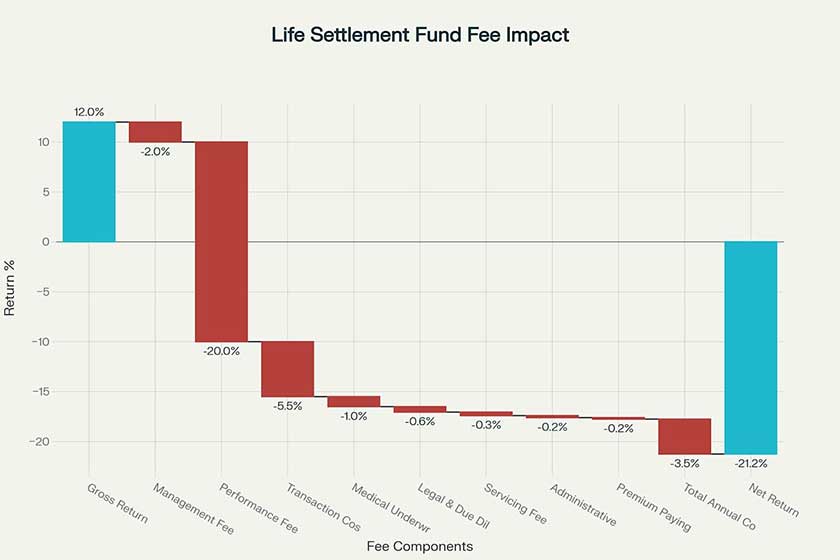
Life settlement fund investments involve several cost components that investors must understand to accurately assess net returns.
Total annual costs typically range from 2.5-4.5% of NAV, with the industry average approximately 3.5%.
Breakdown of life settlement fund fee structure showing impact on investor returns
Management fees typically range from 1.5-2.5% annually on NAV, while performance fees generally follow a 20% structure above hurdle rates. Transaction costs represent 3-8% of purchase price, including broker commissions of 2-6%, while medical underwriting and legal due diligence add 0.5-1.5% and 0.3-0.8% respectively per transaction.
Economic Value Creation Analysis
Despite transaction costs, life settlements create substantial value for both policyholders and investors. Research indicates that policyholders receive approximately four times more value than they would from policy surrender, while investors benefit from attractive risk-adjusted returns uncorrelated with traditional markets.
The fee structure reflects the specialized nature of the investment process, requiring expertise in medical underwriting, actuarial analysis, regulatory compliance, and portfolio management. Professional managers provide comprehensive servicing including premium payments, policy monitoring, and claim processing throughout the investment lifecycle.
Portfolio Strategy Examples
Five distinct case studies illustrate the application of life settlements across different investment strategies and risk profiles.
These examples demonstrate how portfolio construction varies based on investor objectives, from conservative approaches targeting 9% IRR to aggressive institutional strategies seeking 14% returns.
The Conservative Senior Portfolio represents a low-risk approach with 35 policies totaling $25 million face value, targeting stable returns over a 5-year period. In contrast, the Large Institutional Fund demonstrates sophisticated portfolio construction with 200 policies totaling $250 million, incorporating geographic diversification and multiple policy types to optimize risk-adjusted returns.
Performance Validation and Market Evidence
Academic research based on comprehensive policy databases demonstrates the asset class’s potential, with expected returns averaging 12.5% annually across diverse market conditions. Recent market data shows institutional demand remains strong, with 69% of global institutional investors expecting continued allocation increases over the next five years.
Market participants note increasing sophistication in underwriting and valuation methodologies, leading to more accurate pricing and improved risk management capabilities. The regulatory environment continues to evolve favorably, with enhanced market transparency and investor protection measures supporting institutional adoption.
Demographic Drivers and Market Expansion
The life settlement market is positioned for continued growth driven by compelling demographic trends and increased institutional acceptance. An aging population with substantial life insurance coverage creates a growing supply of potential policies for the secondary market, with current market penetration below 3% of eligible policies.
Industry forecasts project market growth from the current $4.5 billion to $5.5 billion by 2033, while gross market potential is expected to rise from approximately $200 billion to $240 billion. The emergence of direct-to-consumer marketing and enhanced regulatory frameworks continue to expand market awareness and transaction volumes.
Institutional Adoption Trends
Institutional investors increasingly view life settlements as responsible investments that provide social benefit while generating attractive returns. The asset class offers pension funds and insurance companies natural hedging opportunities against longevity risk while providing uncorrelated returns for portfolio diversification.
Recent market dynamics, including economic uncertainty and inflation concerns, have created favorable purchasing conditions for life settlement investors, with lower policy prices allowing for enhanced diversification and improved return potential. The combination of demographic tailwinds, regulatory maturation, and institutional acceptance positions the sector for sustained growth.
State-by-State Regulatory Structure
The life settlement industry operates under a comprehensive state-by-state regulatory framework that ensures consumer protection and market transparency. Most states require licensing of life settlement providers and impose minimum standards for policy transactions, including mandatory rescission periods and extensive disclosure requirements.
Key regulatory requirements include licensing of all market participants, minimum policy sizes typically exceeding $100,000, and age requirements generally targeting insureds aged 65 and older. The regulatory environment continues to evolve, with proposed federal oversight potentially bringing life settlements under securities regulations to enhance market credibility.
Compliance Considerations and Market Standards
Market participants must maintain comprehensive compliance programs covering licensing, disclosure, and consumer protection requirements Professional managers typically employ dedicated compliance teams and third-party service providers to ensure adherence to all applicable regulations across multiple jurisdictions.
The regulatory framework provides robust investor protection while maintaining market efficiency, with industry standards emphasizing transparency, fair dealing, and consumer education. As the market continues to mature, regulatory developments are expected to further enhance market credibility and institutional acceptance.
Life settlements represent a compelling alternative investment opportunity that provides unique portfolio diversification benefits and attractive risk-adjusted returns. The asset class’s low correlation with traditional markets, combined with its mortality-driven return profile, makes it a valuable addition to institutional portfolios seeking uncorrelated returns and reduced volatility.
While life settlements involve specific risks that differ from traditional investments, these can be effectively managed through proper diversification, professional management, and comprehensive due diligence. The regulatory environment provides robust investor protection, and market trends suggest continued growth and institutional adoption driven by demographic factors and enhanced market sophistication.
For investors seeking to reduce portfolio volatility while maintaining competitive returns, life settlements offer a unique opportunity to access an alternative return stream that operates independently of financial market cycles. As the market continues to mature and gain institutional acceptance, life settlements are likely to become an increasingly important component of diversified investment portfolios, providing both financial returns and social benefit through enhanced retirement security for American seniors.
This analysis is part of the South Sigma Insights series, providing comprehensive research and strategic analysis for business leaders and financial professionals.
South Sigma Consulting FZCO (“South Sigma”) is an independent investment research and advisory firm providing consulting services to advisory groups, family offices, and institutional investors. Our services include manager sourcing, strategy due diligence, and portfolio design, with a focus on alternative investments such as hedge funds, private markets, real assets, and infrastructure. The information provided by South Sigma is intended solely for sophisticated and professional investors and is for informational and discussion purposes only. It is not intended for retail investors or the general public. South Sigma does not provide financial product advice, nor does it offer, promote, or distribute specific investment products or securities. All research, opinions, and assessments are provided on a non-reliance basis and should not be interpreted as a recommendation to invest, hold, or divest from any particular fund, manager, or strategy. Users are solely responsible for verifying the information provided and conducting their own due diligence. Investment decisions should be made based on independent judgment and, where appropriate, in consultation with qualified financial, legal, and tax advisors. While South Sigma strives to ensure the accuracy and reliability of the information it provides, no warranty or representation is made as to its completeness, accuracy, or fitness for any particular purpose. The information is provided “as is,” and South Sigma disclaims all warranties, express or implied, including but not limited to warranties of merchantability and fitness for a particular purpose. South Sigma does not act as a fiduciary or agent for any party and accepts no liability for any loss arising directly or indirectly from the use of information provided in the course of its consulting services. The information is not a substitute for professional advice. All content is confidential and proprietary to South Sigma Consulting FZCO. It may not be reproduced, distributed, or published without prior written consent from South Sigma.
For inquiries, please contact info@southsigma.com.
Accept Cancel