
Annual Returns 20-50% with Zero Market Correlation: The Asset Class Wall Street Doesn’t Want You to Know About

Strictly for Institutional and Accredited Investors
Understanding Life Settlements as an Asset Class
- Rapidly Growing Market: \$17.5 B in 2024 → \$67.2 B by 2037 (11% CAGR)
- High Returns, Low Correlation: Targeting 20–50% IRR with just 0.05 correlation to equities
- Selective Funding: Only 3–5% of cases get financed, driving win rates of 65–75%
- Reasonable Timelines: Most disputes resolve in 2–3 years, with 85% settling before trial
- Diversification Benefits: 2–5% portfolio allocation across 20–50 cases smooths volatility
- Key Risks & Protections: Use ATE insurance (5–15% cost) and rigorous due diligence for risk control
- Geographic Reach: North America dominates with 45% of the $17.5 B market, followed by the UK (25%), Europe ex-UK (15%), APAC (10%) and RoW (5%) .
- Funding Mechanics: Funders typically take 20–40% of net proceeds and aim for 2–4× multiples on invested capital .
- Insurance Layers: Beyond ATE (5–15%), judgment-preservation insurance runs 3–8%, and defense-cost coverage 6–12% of expected costs .
- Participant Profiles: Specialist funders deploy $1–50 M per case, hedge funds $5–100 M portfolios, PE funds $10–250 M, while sovereign wealth funds exceed $100 M allocations .
- Case-Type Nuances: Patent/IP disputes average 52% IRR on $2.5 M tickets; class actions yield ~26% IRR but need $12 M+ and longer timelines .
- Growth Drivers: Rising legal costs, 74% of lawyers foresee more disputes, and AI-driven case selection are fueling expansion .
Due-Diligence Rigor: Leading managers use multidisciplinary teams—litigators, financial analysts, industry experts—for deep case review and modeling.
Litigation Financing as an Asset Class: A Comprehensive Investment Guide
This comprehensive analysis examines litigation financing as an emerging alternative investment opportunity, providing institutional and sophisticated investors with essential insights into market dynamics, performance characteristics, risk factors, and portfolio integration strategies. The litigation finance sector has evolved from a niche funding mechanism to a sophisticated asset class offering attractive risk-adjusted returns with minimal correlation to traditional markets.
Table of Contents
- Executive Summary
- Market Overview and Structure
- Regulatory and Compliance Considerations
- Insurance and Risk Transfer Mechanisms
- Portfolio Integration and Correlation Analysis
- Portfolio Allocation Strategies
- Return Drivers and Value Creation
- Risk Analysis and Mitigation Strategies
- Market Outlook and Future Trends
- Case Studies and Investment Examples
- Risk Management and Due Diligence Framework
- Conclusion and Investment Implications
- Disclaimer
Executive Summary
Litigation financing represents a rapidly expanding alternative investment sector, with the global market projected to grow from $17.5 billion in 2024 to $67.2 billion by 2037, representing a compound annual growth rate of approximately 11%. This asset class offers investors the opportunity to generate returns of 15-50% annually with correlation coefficients to traditional equity markets of just 0.05, making it an effective portfolio diversifier. The sector demonstrates strong fundamentals with historical win rates around 50% and settlement rates of 73%, while providing access to legal claims that would otherwise remain unfunded due to capital constraints.
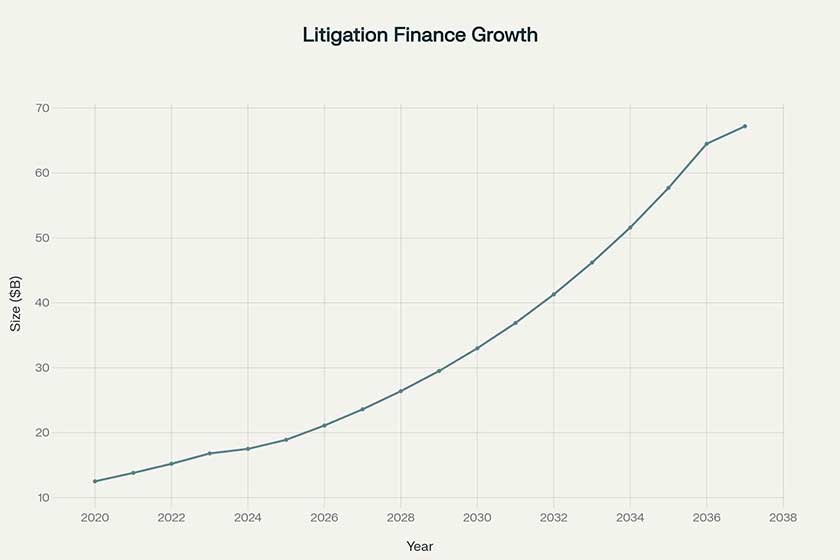
The global market has reached $17.5 billion in 2024 and is projected to grow to $67.2 billion by 2037, representing a compound annual growth rate of 11.1%. This growth trajectory reflects increasing acceptance among legal practitioners, corporations, and institutional investors seeking uncorrelated returns in an environment of heightened market volatility.
Market Overview and Structure
Definition and Mechanics
Litigation financing involves third-party investors providing capital to fund legal proceedings in exchange for a portion of any successful outcome. Unlike traditional legal fee arrangements, litigation funders typically receive no return if the case is unsuccessful, creating an asymmetric risk-return profile that can generate substantial returns when cases succeed. The funding model typically involves funders receiving 20-40% of net proceeds plus recovery of invested capital, with some arrangements offering multiple returns of 2-4x invested capital.
Market Size and Growth Trajectory
The litigation finance market has experienced remarkable growth over the past decade, expanding from approximately $12.5 billion in 2020 to current estimates of $17.5 billion in 2024. Market projections indicate continued robust expansion, with leading research firms forecasting the market will reach $67.2 billion by 2037. This growth trajectory reflects increasing acceptance of litigation funding among legal practitioners, corporations, and institutional investors seeking uncorrelated returns.
The market expansion is driven by several structural factors including rising legal costs, increased corporate adoption of strategic litigation funding, and growing institutional investor interest in uncorrelated returns. The total addressable market remains substantial, with estimates suggesting only a small fraction of potential cases currently receive third-party funding.
Key Market Participants
The litigation finance ecosystem comprises specialized funding firms, hedge funds, sovereign wealth funds, and institutional investors. Leading market participants include established firms with significant assets under management and proven track records in case selection and portfolio management.
Geographic Market Distribution
The global litigation finance market exhibits significant geographic concentration, reflecting differences in regulatory frameworks, legal systems, and market maturity levels across jurisdictions. North America dominates the global market, accounting for 45% of total activity valued at $7.875 billion, followed by the United Kingdom at 25% with $4.375 billion in market activity.
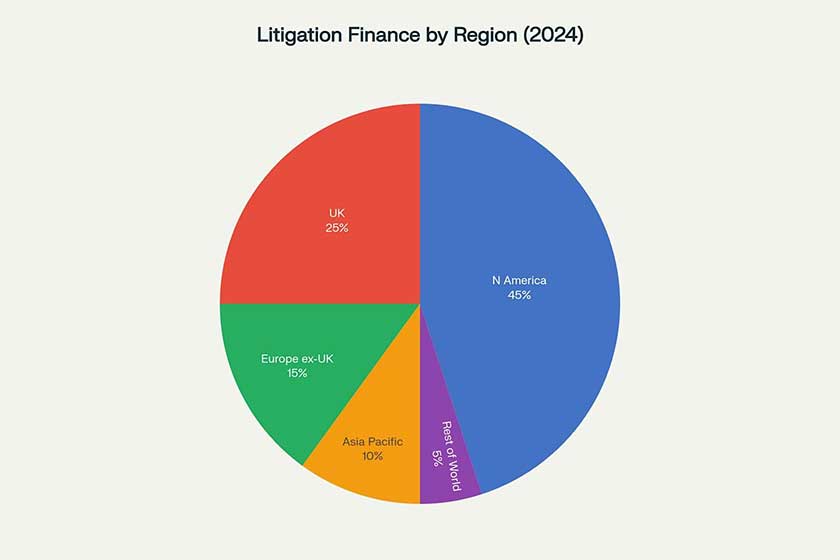
Geographic distribution of the global litigation financing market in 2024, showing North America’s dominance at 45% market share, followed by the UK at 25%.
Europe excluding the UK represents 15% of the market ($2.625 billion), while Asia Pacific accounts for 10% ($1.75 billion), and the rest of the world comprises 5% ($0.875 billion). The regulatory environment varies considerably by jurisdiction, with some markets offering well-established legal frameworks while others are developing appropriate oversight mechanisms.
Market Participants and Investment Approaches
The litigation finance ecosystem comprises diverse participant types, each with distinct investment strategies and capital deployment approaches. Specialist litigation funders typically invest $1-50 million per case using both single-case and portfolio approaches, while hedge funds deploy $5-100 million in portfolio strategies with leverage.
Private equity funds structure $10-250 million funds with diversification across multiple cases and practice areas. Institutional investors allocate $50-500 million as part of broader alternative investment strategies, while high net worth individuals make direct case investments ranging from $100,000 to $10 million. Sovereign wealth funds represent the largest category, making strategic allocations exceeding $100 million.
Historical Performance and Returns
Performance Metrics and Benchmarks
Litigation finance has demonstrated attractive historical returns, with leading firms achieving cumulative returns on invested capital (ROIC) of 70-90% over their operating history. The asset class typically targets internal rates of return (IRR) of 20-50% annually, with many investments achieving or exceeding these targets. Case resolution times average 2-3 years, providing relatively predictable investment horizons compared to other alternative assets.
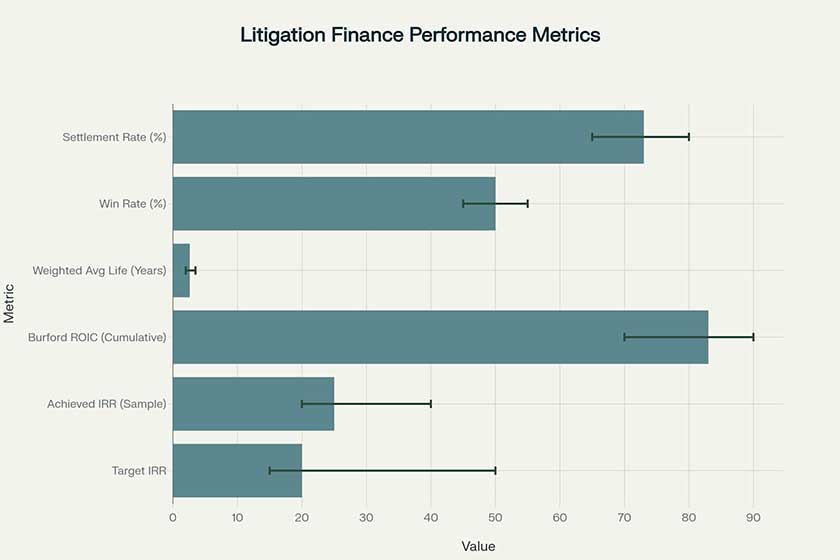
Key performance metrics for litigation finance investments showing expected returns and risk characteristics
The performance characteristics of litigation finance reflect the binary nature of legal outcomes, where cases either succeed and generate substantial returns or fail and result in total loss. This risk profile requires sophisticated portfolio construction and case selection capabilities to achieve target returns while managing downside risk.
Investment Categories and Case Type Analysis
Distribution Across Legal Practice Areas
The litigation finance market exhibits distinct concentration patterns across different legal categories, with commercial litigation representing the largest segment at 35% of total cases. Intellectual property disputes account for 25% of cases but command higher average investments of $6.2 million per case, while international arbitration represents 20% of cases with the highest average investment of $8.5 million.
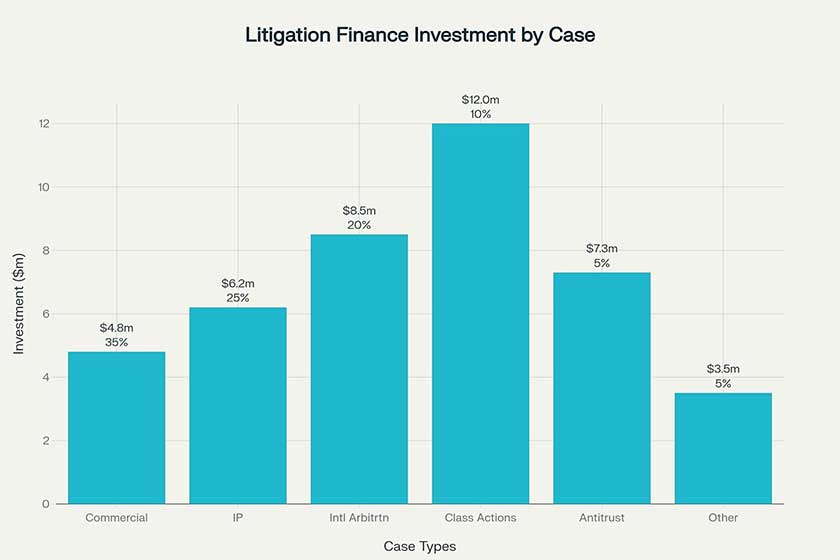
Analysis of litigation finance investments by case type, showing commercial litigation dominates at 35% of cases while international arbitration commands the highest average investment at $8.5 million.
Class actions comprise 10% of cases but require the largest average investments at $12.0 million, reflecting the scale and complexity of mass tort and consumer litigation. Antitrust cases represent 5% of the market with average investments of $7.3 million, while other specialized areas account for the remaining 5% with average investments of $3.5 million.
Case Selection Criteria and Due Diligence
Effective case selection requires comprehensive due diligence processes combining legal merit assessment, financial analysis, and strategic considerations. Leading funders employ multidisciplinary teams including experienced litigators, financial analysts, and industry experts to evaluate potential investments. The evaluation process typically involves detailed case document review, expert legal opinions, and financial modeling of potential outcomes.
Industry data indicates that funders accept only 3-5% of funding opportunities presented, demonstrating the selective nature of the investment process. This selectivity contributes to the asset class’s strong performance but also limits scalability for broader access to justice applications.
Comparative Analysis with Traditional Asset Classes
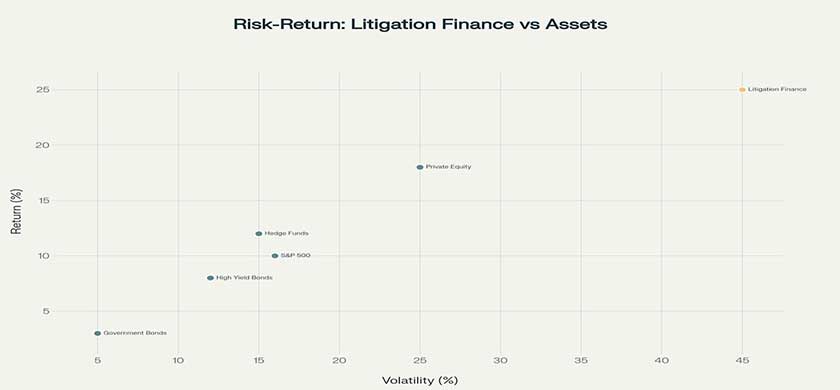
Litigation finance demonstrates remarkably low correlation with traditional asset classes, offering genuine diversification benefits for institutional portfolios. The correlation coefficient between litigation finance returns and the S&P 500 is approximately 0.05, compared to 0.85 for private equity and 0.75 for high-yield bonds.
Analysis of litigation finance investments by case type, showing commercial litigation dominates at 35% of cases while international arbitration commands the highest average investment at $8.5 million.
Class actions comprise 10% of cases but require the largest average investments at $12.0 million, reflecting the scale and complexity of mass tort and consumer litigation. Antitrust cases represent 5% of the market with average investments of $7.3 million, while other specialized areas account for the remaining 5% with average investments of $3.5 million.
Case Selection Criteria and Due Diligence
Effective case selection requires comprehensive due diligence processes combining legal merit assessment, financial analysis, and strategic considerations. Leading funders employ multidisciplinary teams including experienced litigators, financial analysts, and industry experts to evaluate potential investments. The evaluation process typically involves detailed case document review, expert legal opinions, and financial modeling of potential outcomes.
Industry data indicates that funders accept only 3-5% of funding opportunities presented, demonstrating the selective nature of the investment process. This selectivity contributes to the asset class’s strong performance but also limits scalability for broader access to justice applications.
Comparative Analysis with Traditional Asset Classes
Litigation finance demonstrates remarkably low correlation with traditional asset classes, offering genuine diversification benefits for institutional portfolios. The correlation coefficient between litigation finance returns and the S&P 500 is approximately 0.05, compared to 0.85 for private equity and 0.75 for high-yield bonds.
Risk Analysis and Mitigation Strategies
Primary Risk Categories
Litigation finance involves several distinct risk categories that require specialized expertise and mitigation strategies. Case selection risk represents the primary concern, as the binary nature of legal outcomes can result in total loss of invested capital. Duration risk affects return calculations, as extended case timelines can reduce effective yields even when cases ultimately succeed.
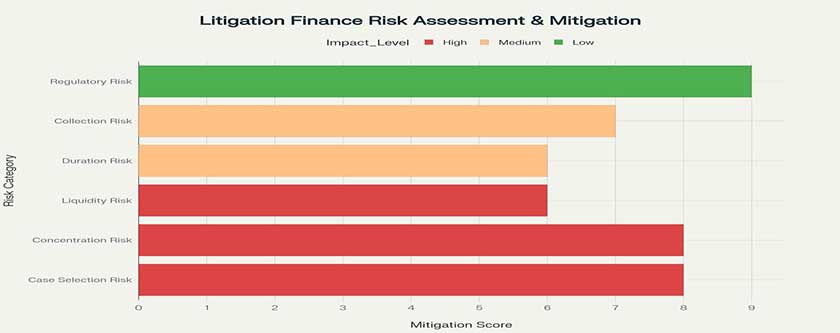
Risk assessment showing various litigation finance risks and their mitigation effectiveness scores
Risk Mitigation Approaches
Effective risk management in litigation finance relies on portfolio diversification, rigorous due diligence processes, and ongoing case monitoring. Leading funders employ teams of legal experts, financial analysts, and industry specialists to evaluate potential investments and monitor portfolio companies throughout the litigation process. Portfolio construction typically involves 20-50 individual cases across different practice areas and jurisdictions to reduce concentration risk.
Regulatory and Compliance Considerations
The regulatory environment for litigation finance continues to evolve, with increasing focus on disclosure requirements and ethical considerations. Investors must consider jurisdiction-specific regulations that may affect funding arrangements or require disclosure of funding sources. Recent regulatory developments have generally supported the growth of litigation finance while establishing appropriate oversight mechanisms.
Market Outlook and Growth Projections
Demographic Drivers and Market Expansion
The life settlement market is positioned for continued growth driven by compelling demographic trends and increased institutional acceptance. An aging population with substantial life insurance coverage creates a growing supply of potential policies for the secondary market, with current market penetration below 3% of eligible policies.
Industry forecasts project market growth from the current $4.5 billion to $5.5 billion by 2033, while gross market potential is expected to rise from approximately $200 billion to $240 billion. The emergence of direct-to-consumer marketing and enhanced regulatory frameworks continue to expand market awareness and transaction volumes.
Institutional Adoption Trends
Institutional investors increasingly view life settlements as responsible investments that provide social benefit while generating attractive returns. The asset class offers pension funds and insurance companies natural hedging opportunities against longevity risk while providing uncorrelated returns for portfolio diversification.
Recent market dynamics, including economic uncertainty and inflation concerns, have created favorable purchasing conditions for life settlement investors, with lower policy prices allowing for enhanced diversification and improved return potential. The combination of demographic tailwinds, regulatory maturation, and institutional acceptance positions the sector for sustained growth.
Insurance and Risk Transfer Mechanisms
Insurance Product Categories and Cost Structure
The insurance landscape encompasses several product categories designed to address different aspects of litigation risk. ATE insurance covers adverse cost orders and own disbursements at costs of 5-15% of coverage amount, while portfolio insurance provides broader coverage at 8-12% of total portfolio value.
Judgment preservation insurance protects awarded judgments at costs of 3-8% of judgment amount, while defense cost coverage enables strategic defense funding at 6-12% of expected defense costs. These products collectively provide comprehensive risk management capabilities for litigation finance portfolios.
The litigation finance ecosystem has developed sophisticated insurance products to help manage risk and improve investment returns. After-the-Event (ATE) insurance represents the most common form of coverage, protecting funders against adverse cost orders if cases are unsuccessful. These insurance products typically cost 5-15% of coverage amounts and can significantly improve the risk-return profile of litigation investments.
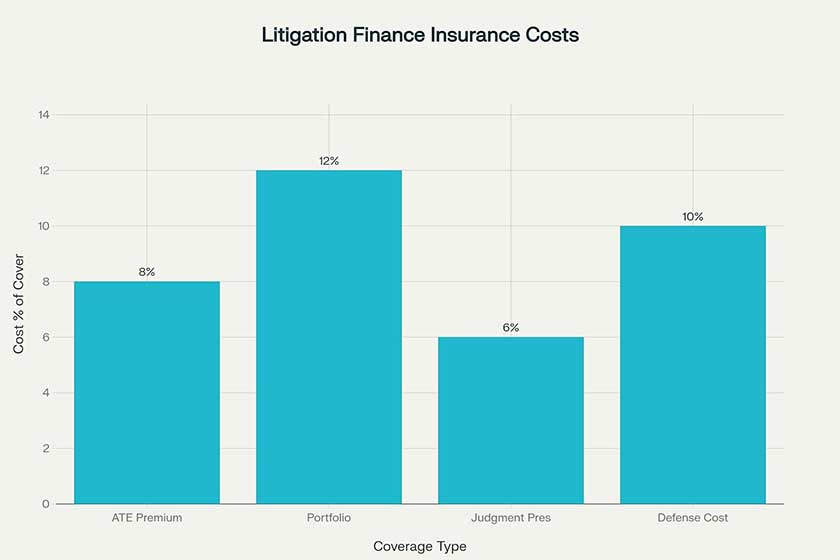
Insurance cost structure for litigation finance showing ATE insurance premiums typically cost 8% of coverage, while portfolio insurance costs 12% due to broader risk coverage.
Portfolio ATE insurance provides coverage across multiple cases, potentially reducing overall insurance costs while maintaining protection against adverse outcomes. The insurance market for litigation finance has matured significantly, offering increasingly sophisticated products tailored to different case types and funding arrangements.
Coverage Optimization Strategies
Successful litigation finance strategies often combine multiple insurance products to create comprehensive risk management frameworks. Portfolio insurance can provide coverage across multiple cases, potentially reducing overall insurance costs while maintaining protection against adverse outcomes. The insurance market for litigation finance has matured significantly, offering increasingly sophisticated products tailored to different case types and funding arrangements.
Portfolio Integration and Correlation Analysis
Risk-Return Profile Analysis by Case Type
Different categories of litigation present distinct risk-return characteristics that investors must understand for effective portfolio construction. Commercial litigation typically offers the highest returns with shorter durations, while international arbitration provides more moderate returns over extended timeframes.
The analysis reveals that commercial litigation cases average 1.8 years duration with IRR potential of 89%, while international arbitration cases extend to 3.5 years but provide more stable returns averaging 35% IRR. Class action lawsuits require the largest average investments at $12 million but offer lower IRR returns of 26% due to their complexity and extended timelines.
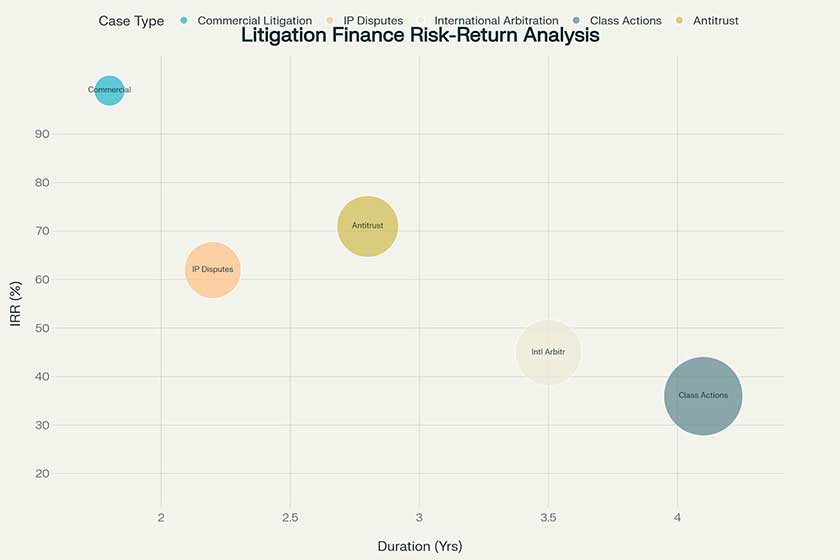
Risk-Return Profile Analysis of Litigation Financing by Case Type
Correlation Characteristics
Litigation finance demonstrates remarkably low correlation with traditional asset classes, offering genuine diversification benefits for institutional portfolios. The correlation coefficient between litigation finance returns and the S&P 500 is approximately 0.05, compared to 0.85 for private equity and 0.75 for high-yield bonds. This low correlation stems from the fact that litigation outcomes are generally independent of macroeconomic conditions and market cycles.
Risk-Return Analysis: Litigation Finance Versus Traditional Asset Classes
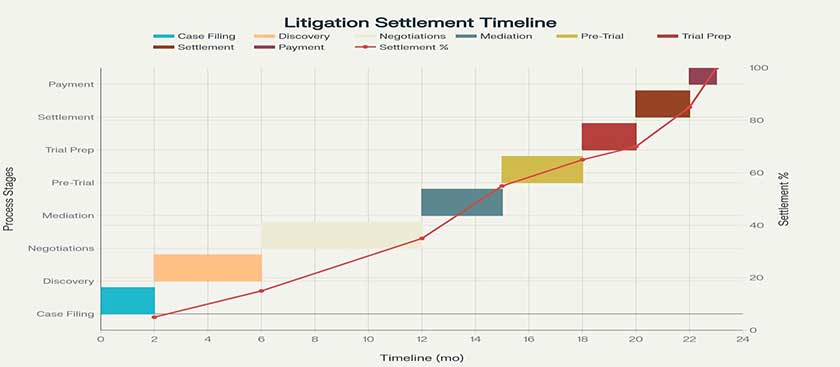
Settlement Process Timeline and Success Probability Analysis
Understanding the litigation settlement process is crucial for investors as it directly impacts return timing and probability. The typical litigation lifecycle spans 22-24 months, with distinct phases offering varying settlement probabilities.
Research indicates that 35% of cases settle during initial negotiations around month 6, while 55% resolve after mediation or arbitration by month 15. Approximately 85% of all funded cases settle before trial commencement, significantly reducing risk exposure for investors.
Litigation Settlement Process Timeline with Cumulative Settlement Probabilities
Portfolio Allocation Strategies
Optimal portfolio construction in litigation finance requires careful attention to case type diversification and geographic distribution. Industry best practices suggest allocating investments across commercial litigation (35%), intellectual property cases (25%), international arbitration (20%), class actions (10%), and other specialized areas (10%).
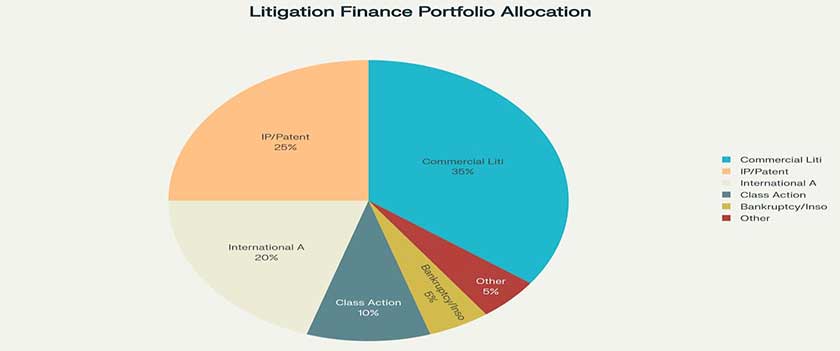
Recommended portfolio allocation across different litigation case types for optimal diversification
Diversification Benefits
The uncorrelated nature of litigation finance returns provides significant portfolio benefits, particularly during periods of market stress when traditional asset correlations tend to increase. Academic research suggests that even modest allocations to litigation finance (2-5% of total portfolio) can improve risk-adjusted returns while reducing overall portfolio volatility.
Market Outlook and Future Trends
Growth Drivers and Market Expansion
Several structural factors support continued growth in litigation finance, including rising legal costs, increasing acceptance among legal practitioners, and growing institutional investor interest. The total addressable market for litigation finance remains substantial, with estimates suggesting only a small fraction of potential cases currently receive third-party funding. Corporate adoption of litigation finance as a strategic tool for managing legal costs and risks continues to accelerate.
Technological Innovation and Market Evolution
The litigation finance industry is increasingly leveraging technology and data analytics to improve case selection and portfolio management. Artificial intelligence and machine learning tools are being deployed to analyze case documents, predict outcomes, and optimize settlement strategies. These technological advances may help reduce information asymmetries and improve overall market efficiency.
Regulatory Development and Market Maturation
Regulatory frameworks for litigation finance continue to evolve, with most jurisdictions moving toward greater acceptance and standardization. Recent legislative and judicial developments have generally supported the legitimacy of litigation funding while establishing appropriate disclosure and oversight requirements. Market maturation is evident in the increasing sophistication of participants, standardization of documentation, and development of secondary markets.
Case Studies and Investment Examples
Representative Investment Outcomes
The following case studies illustrate the diversity of litigation finance investments and their potential returns across different practice areas and case types. These examples demonstrate both the upside potential and inherent risks of litigation finance investing, highlighting the importance of portfolio diversification and professional management.
Patent Infringement Case Study
A technology company received $2.5 million in funding for a patent infringement claim against a Fortune 500 competitor. The case settled after 2.2 years for a total recovery that provided investors with a 3.2x multiple and 52% IRR. This example illustrates the attractive returns possible in intellectual property disputes while demonstrating the importance of strong patent positions and experienced legal counsel.
Commercial Breach of Contract
An $1.8 million investment in a commercial breach of contract case resulted in a favorable trial verdict after 1.8 years. The successful outcome generated a 4.1x return multiple and 89% IRR for investors]. This case highlights the potential for exceptional returns in well-selected commercial disputes with clear liability and substantial damages.
International Arbitration Award
A complex international arbitration required $8.0 million in funding over 3.5 years before achieving a favorable arbitration award. Despite the longer duration, the case generated solid returns with a 2.8x multiple and 35% IRR. This example demonstrates the risk-return profile typical of large, complex international disputes.
Risk Management and Due Diligence Framework
Investment Evaluation Process
Successful litigation finance requires rigorous due diligence processes combining legal merit assessment, financial analysis, and strategic considerations. Leading funders employ multidisciplinary teams including experienced litigators, financial analysts, and industry experts to evaluate potential investments. The evaluation process typically involves detailed case document review, expert legal opinions, and financial modeling of potential outcomes.
Portfolio Construction Principles
Effective portfolio construction in litigation finance requires balancing multiple factors including case type, jurisdiction, size, expected duration, and legal counsel quality. Most professional managers target portfolios of 20-50 cases to achieve adequate diversification while maintaining the ability to conduct thorough due diligence on each investment. Geographic and practice area diversification help reduce correlation between individual cases and improve overall portfolio stability.
Conclusion and Investment Implications
Litigation finance has emerged as a compelling alternative investment opportunity offering attractive risk-adjusted returns with minimal correlation to traditional asset classes. The sector’s strong growth trajectory, driven by increasing legal costs and growing institutional acceptance, suggests continued expansion of investment opportunities. However, successful participation in this market requires specialized expertise, sophisticated risk management capabilities, and patient capital given the typical 2-4 year investment horizons.
For institutional investors, litigation finance represents an opportunity to access a large and growing market while achieving portfolio diversification benefits that are increasingly difficult to obtain in traditional asset classes. The asset class is particularly attractive for investors seeking uncorrelated returns and willing to accept the binary risk profile inherent in legal outcomes. As the market continues to mature and institutional participation increases, litigation finance is positioned to become an established component of diversified alternative investment portfolios.
The sector’s evolution from niche funding mechanism to institutional asset class reflects broader trends toward alternative investments and the search for uncorrelated returns in an increasingly interconnected global economy. While risks remain significant and specialized expertise is essential, the compelling return potential and diversification benefits make litigation finance worthy of serious consideration by sophisticated investors.
This analysis is part of the South Sigma Insights series, providing comprehensive research and strategic analysis for Accredited Investors.

Have a question?
Markets Insights & Strategy




Asset Strategy Intelligence
- Annual Returns 20-50% with Zero Market Correlation: The Asset Class Wall Street Doesn’t Want You to Know About

- Evaluating External Fund Managers in 2025
- How Private Credit Funds Are Delivering 11% Returns While Bonds Struggle

- Life Settlement Funds: A Comprehensive Investment Guide for Institutional and Sophisticated Investors

Research South Sigma Disclaimer
South Sigma Consulting FZCO (“South Sigma”) is an independent investment research and advisory firm providing consulting services to advisory groups, family offices, and institutional investors. Our services include manager sourcing, strategy due diligence, and portfolio design, with a focus on alternative investments such as hedge funds, private markets, real assets, and infrastructure. The information provided by South Sigma is intended solely for sophisticated and professional investors and is for informational and discussion purposes only. It is not intended for retail investors or the general public. South Sigma does not provide financial product advice, nor does it offer, promote, or distribute specific investment products or securities. All research, opinions, and assessments are provided on a non-reliance basis and should not be interpreted as a recommendation to invest, hold, or divest from any particular fund, manager, or strategy. Users are solely responsible for verifying the information provided and conducting their own due diligence. Investment decisions should be made based on independent judgment and, where appropriate, in consultation with qualified financial, legal, and tax advisors. While South Sigma strives to ensure the accuracy and reliability of the information it provides, no warranty or representation is made as to its completeness, accuracy, or fitness for any particular purpose. The information is provided “as is,” and South Sigma disclaims all warranties, express or implied, including but not limited to warranties of merchantability and fitness for a particular purpose. South Sigma does not act as a fiduciary or agent for any party and accepts no liability for any loss arising directly or indirectly from the use of information provided in the course of its consulting services. The information is not a substitute for professional advice. All content is confidential and proprietary to South Sigma Consulting FZCO. It may not be reproduced, distributed, or published without prior written consent from South Sigma.
For inquiries, please contact info@southsigma.com.
Accept Cancel