
The promise of artificial intelligence in investing has captured the imagination of institutional investors worldwide, generating both breathless excitement and paralyzing fear. Walk through any asset management conference today, and you’ll hear the same refrain: AI will either revolutionize alpha generation or destroy human judgment entirely. Yet after billions in AI investments and countless pilot programs, most institutional efforts remain underwhelming at best.
Here’s the uncomfortable truth: while 86% of hedge fund managers now permit staff to use AI tools, and 74% of companies struggle to achieve tangible value from their AI implementations, the industry continues to misunderstand what AI can actually do versus what it should do. The real question isn’t whether AI will change investing—it’s why institutions persist in applying 21st-century technology to 20th-century thinking.
Most institutional investors approach AI with a singular obsession: can it generate alpha? This narrow focus has led to a cascade of strategic errors that undermine the technology’s transformative potential. While firms chase elusive predictive models and algorithmic trading signals, they’re missing the profound operational advantages that AI delivers today—not someday.
The numbers tell a stark story. According to recent BCG research, only 26% of companies have developed the necessary capabilities to move beyond proofs of concept and generate tangible value. Meanwhile, firms that successfully integrate AI report 1.5 times higher revenue growth and 1.6 times greater shareholder returns. The difference isn’t in the technology—it’s in how it’s applied.
The Tech-First Fallacy
The most pervasive error is treating AI as a technical bolt-on rather than a strategic capability. Too many institutions start with the algorithm instead of the problem. They hire data scientists, buy expensive platforms, and launch pilots without first identifying which processes actually need enhancement.
Consider the typical implementation: a hedge fund invests $5 million in a machine learning platform to identify market anomalies, only to discover that their existing research process can’t incorporate the signals fast enough to be actionable. The technology works perfectly; the integration fails completely.
Successful AI implementation requires domain-first thinking. McKinsey’s research on asset management shows that firms achieving significant impact focus on “domain-based transformation through zero-based, AI-enabled redesign of workflows” rather than fragmented use cases. One top-30 asset manager shifted from pursuing hundreds of individual use cases to four high-potential functions—operations, marketing, distribution, and investment management—with tracked ROI targets for each AI effort.
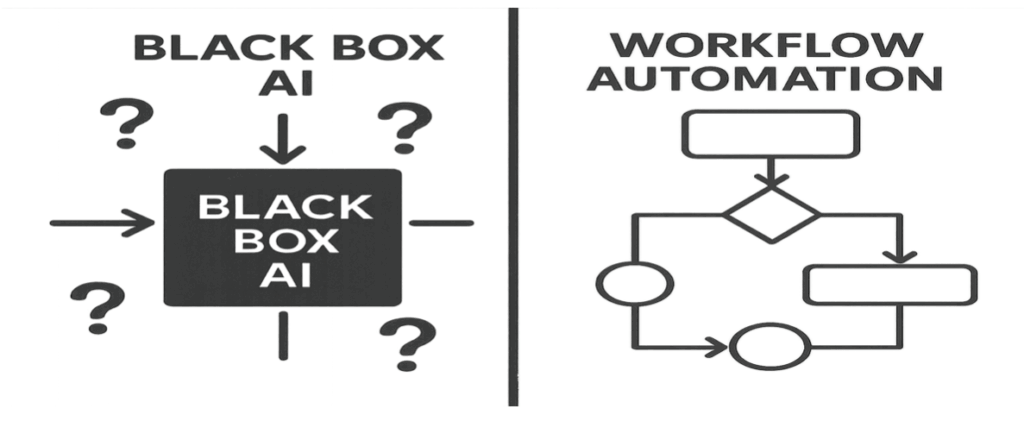
Black box AI versus transparent workflow automation
Over-Indexing on Predictive Models
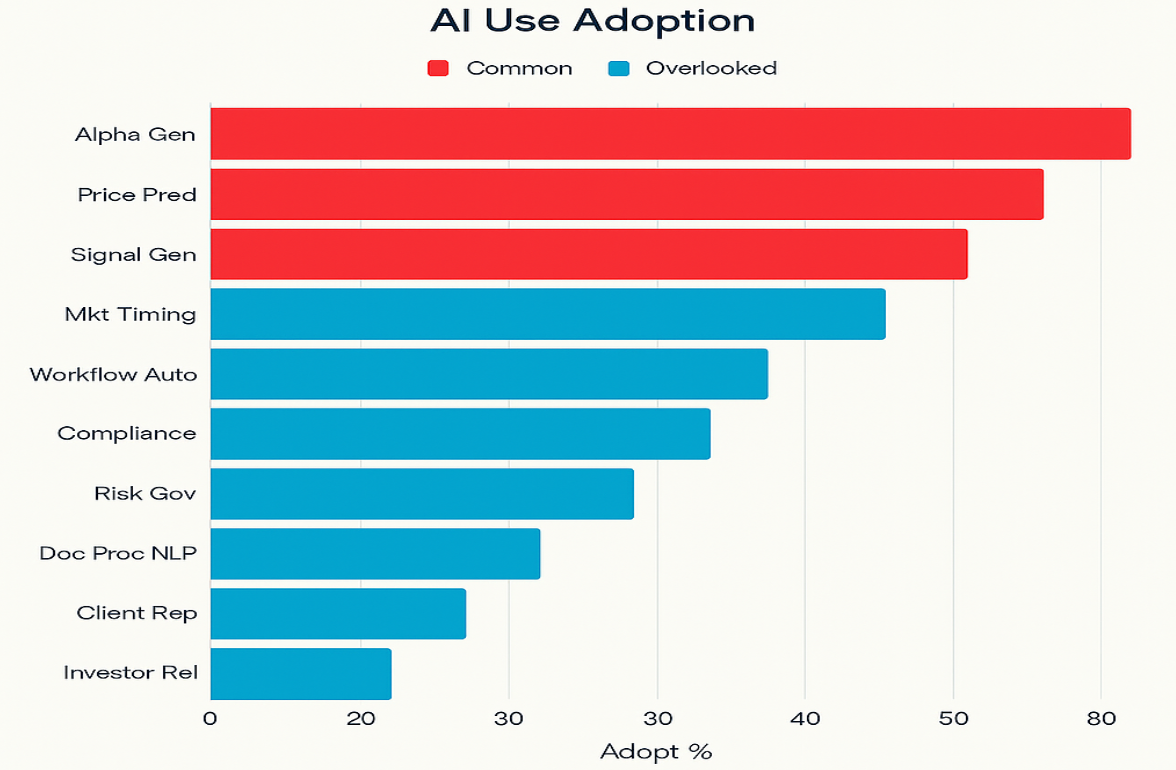
The second major mistake is the obsessive focus on alpha signals and price prediction. While 85% of institutions prioritize AI for alpha generation, this represents a fundamental misallocation of resources. The evidence for AI-driven alpha generation remains mixed at best, yet institutions continue to chase increasingly sophisticated models that promise market-beating returns.
Recent research reveals a sobering reality: “Most recently, machine learning has enabled predictive models across asset classes and risk domains, but the integration of AI-driven alpha strategies remains constrained by several systemic barriers”. These include overfitting in non-stationary environments, limited interpretability, and latency issues in high-frequency applications.
The irony is stark: while institutions struggle to extract alpha from AI, they’re ignoring applications where the technology delivers measurable, immediate value. Document processing automation can reduce due diligence time by 70%. NLP for earnings call analysis provides consistent, bias-free sentiment extraction. Risk governance systems flag compliance issues in real-time rather than quarterly reviews.
AI Use Cases in Institutional Investing: Common vs. Overlooked Opportunities
Black Box Risk Aversion
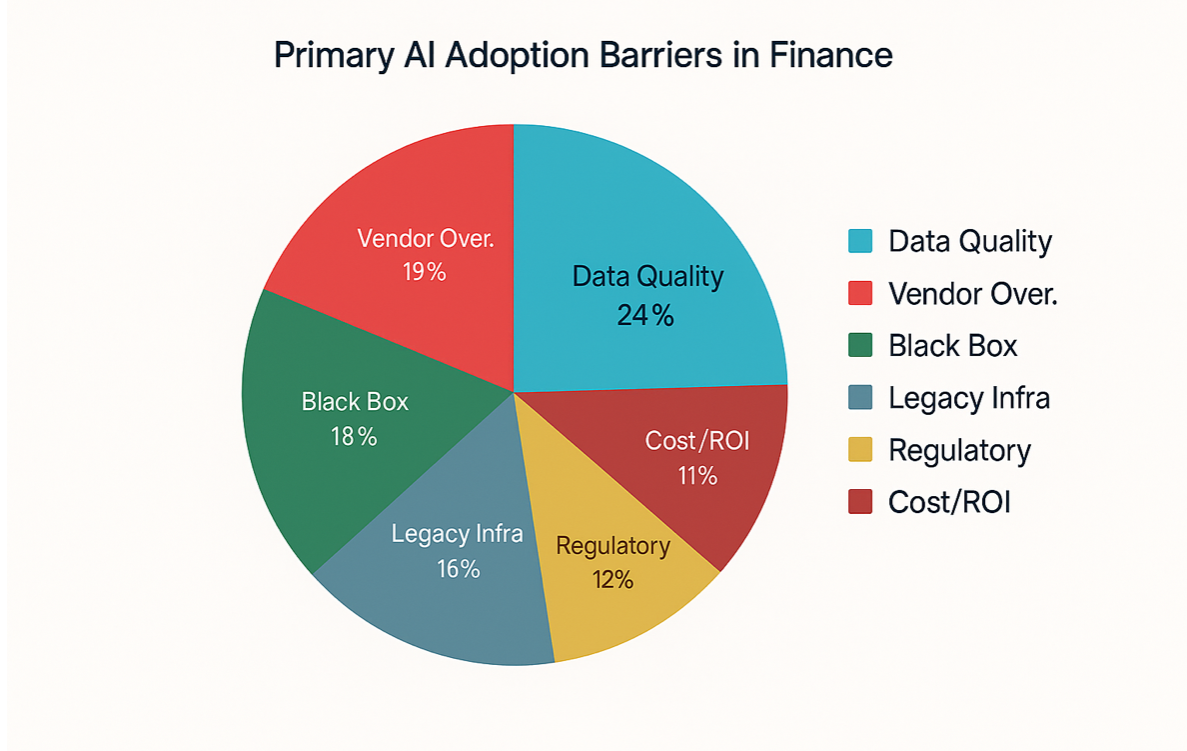
Fear of explainability often kills useful experimentation. Institutional investors, conditioned by regulatory requirements and fiduciary responsibilities, demand transparency in decision-making. When presented with AI models that can’t explain their logic, many firms reject the technology entirely rather than find appropriate use cases.
This binary thinking—transparent or nothing—ignores the spectrum of AI applications. Not every use case requires the same level of explainability. Using AI to summarize earnings transcripts demands less interpretability than using it for credit decisions. Yet many institutions apply the same rigid standards across all applications.
The financial services industry is particularly susceptible to this error. As one compliance officer noted, “We spent six months trying to make our fraud detection model 100% explainable, when our existing rules-based system was already making decisions we couldn’t fully justify”. The perfect became the enemy of the good.
Primary Barriers to AI Adoption in Institutional Finance
Poor Data Foundations
Garbage in, garbage out has never been more relevant. Poor data quality costs organizations an average of $12.9 million annually, yet many institutions launch AI initiatives without addressing fundamental data hygiene issues. They expect algorithmic sophistication to overcome data fragmentation, inconsistency, and incompleteness.
The problem is particularly acute in alternative investments, where data sources are diverse and often unstructured. Private equity firms trying to implement AI for due diligence discover that their historical deal documents are stored in incompatible formats across different platforms. Asset managers find that their portfolio data lacks the granularity needed for meaningful pattern recognition.
AI amplifies existing data problems rather than solving them. As one CTO at a major fund explained: “We thought machine learning would help us make sense of messy data. Instead, it just made bad decisions faster”. The solution requires upfront investment in data architecture and governance—unsexy infrastructure work that creates the foundation for AI success.
Vendor Overreliance
The final major mistake is outsourcing AI strategy to technology providers. Faced with internal skill gaps and competitive pressure, many institutions delegate AI decisions to vendors who promise turnkey solutions. This approach creates dependency and loses the strategic control necessary for differentiation.
Vendor solutions often optimize for broad applicability rather than specific institutional needs. A hedge fund using off-the-shelf sentiment analysis might find that the model performs well on general news but misses industry-specific signals that human analysts consider critical. The result is technically functional but strategically useless.
More concerning is the loss of institutional learning. When AI capabilities reside entirely with external providers, internal teams never develop the expertise needed to evaluate, improve, or expand these systems. They become consumers rather than builders, dependent on vendors for strategic advantage.
While institutions struggle with alpha generation fantasies, AI is quietly revolutionizing the operational backbone of investment management. The most successful implementations focus on process leverage and decision augmentation rather than prediction and automation.
Workflow Automation: The Unsexy Winner
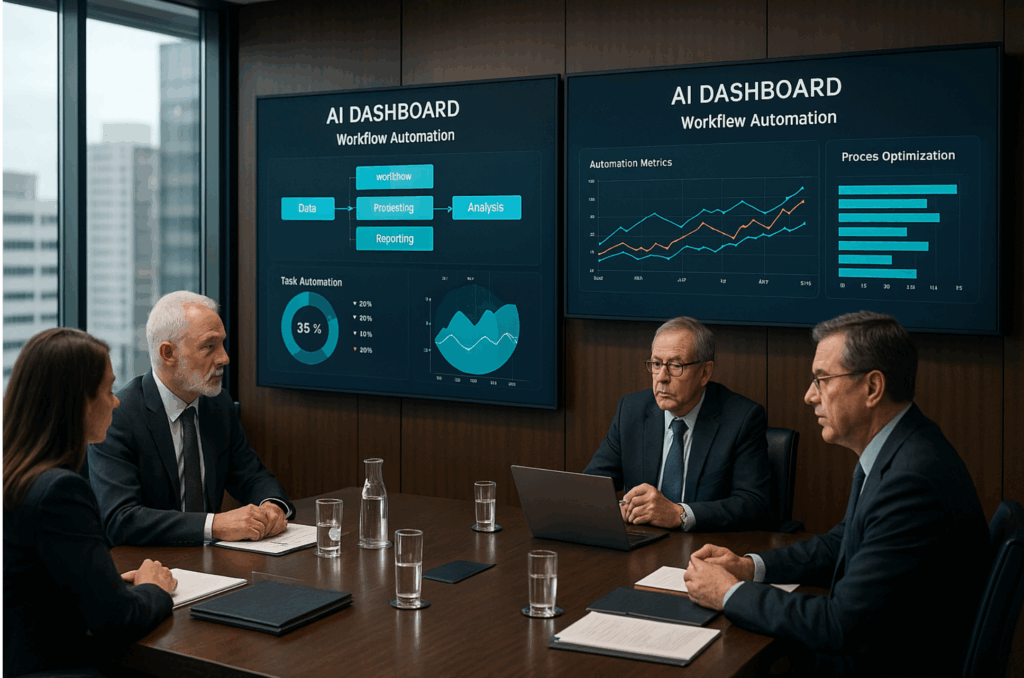
The highest-impact AI applications are often the least glamorous. Workflow automation delivers immediate, measurable value with minimal implementation risk. Consider due diligence processes in private equity, where AI-powered document processing can reduce analysis time by 76.8% while improving accuracy by 42.3%.
One private equity firm implemented AI for document review and saved nearly 1,100 hours per year in provisional credit processing alone. Another used AI to automate journal voucher posting, reimbursing members much sooner while reducing operational overhead. These applications don’t generate alpha—they generate efficiency.
The compound effect is significant. By automating routine tasks, AI frees skilled professionals for higher-value activities. Investment teams can spend more time on strategic analysis and relationship building rather than data compilation and administrative processes. The ROI is immediate and sustainable.
NLP for Document Processing: Unlocking Unstructured Value
Financial institutions process enormous volumes of unstructured text—earnings transcripts, regulatory filings, research reports, and legal documents. Natural Language Processing transforms this information from cost center to competitive advantage.
Hedge funds use NLP to analyze earnings call sentiment with 98%+ accuracy, identifying management confidence levels and forward-looking statements that traditional analysis might miss. Asset managers apply NLP to extract key metrics from 10-K filings automatically, creating structured datasets for quantitative analysis.
The technology excels at tasks that are tedious for humans but straightforward for algorithms: entity recognition, sentiment scoring, and thematic classification. One hedge fund saved $5 million annually by using AI for compliance document review, automatically detecting potential insider information in research interviews.
Augmenting Risk Governance
Perhaps the most valuable AI application is enhancing institutional risk management and operational due diligence. Unlike predictive models that aim to forecast market movements, risk governance AI identifies patterns in existing processes and flags anomalies in real-time.
AI-powered compliance monitoring can detect regulatory violations as they occur rather than during quarterly reviews. Transaction monitoring systems use machine learning to identify unusual patterns that may indicate operational failures or compliance breaches. Portfolio risk systems can simulate thousands of scenarios in minutes rather than hours.
The key insight is that risk management benefits from AI’s pattern recognition capabilities without requiring perfect prediction. The system doesn’t need to forecast specific risks—it needs to identify deviations from normal patterns and alert human oversight.
Capital Allocation Framework Enhancement
AI transforms capital allocation from periodic exercise to dynamic, data-driven process. Advanced scenario modeling allows institutions to evaluate investment decisions under multiple market conditions simultaneously, testing portfolio resilience against various stress scenarios.
CFOs using AI-powered scenario planning can align funding decisions to real-time liquidity shifts, evaluate downstream impacts of capital allocation changes, and model complex interdependencies across business units. One study found that firms implementing AI in finance operations reported a 38% enhancement in productivity and 40% reduction in operational costs.
The technology is particularly powerful for infrastructure investment decisions, where AI can integrate geospatial data, regulatory changes, and market dynamics to optimize capital deployment across multiple projects and time horizons.
Client Servicing and IR at Scale
AI enables personalized client communication at institutional scale. Rather than generic reporting, AI systems can generate customized communications based on individual client preferences, portfolio characteristics, and market conditions.
Investor relations teams use AI to automate preliminary earnings releases, create investor presentations, and handle routine stakeholder inquiries. Chatbots and virtual assistants provide 24/7 support for basic account management tasks, freeing human resources for strategic relationship management.
The compound effect is significant: enhanced personalization improves client satisfaction and retention while reducing operational costs and scaling team capabilities.
Hedge Fund Success: From Compliance Burden to Competitive Advantage
One leading hedge fund transformed its compliance process using AI for Material Non-Public Information (MNPI) detection. Previously, compliance officers spent hours manually reviewing expert interviews for potential insider information. The AI system now flags potential risks in real-time, enabling the fund to conduct more expert interviews while maintaining compliance standards.
The implementation saved the fund $5 million annually while improving research capabilities. More importantly, it demonstrated how AI can turn regulatory requirements into operational advantages rather than viewing compliance as pure cost.
Private Equity: Document Processing at Scale
A private equity firm struggling with due diligence bottlenecks implemented AI-powered document processing for deal evaluation. The system automatically extracts key financial metrics, contract terms, and risk factors from thousands of pages of documentation.
The result: 70% reduction in document processing time and 98%+ accuracy in data extraction. The firm can now evaluate more deals without proportional increases in staffing, while analysts focus on strategic analysis rather than data compilation.
Asset Management: Operational Efficiency Through Automation
A mid-sized asset manager with $500 billion in AUM implemented comprehensive AI automation across back-office functions. McKinsey analysis suggests such firms can capture 25-40% of total cost base in efficiencies through end-to-end workflow reimagination.
The implementation focused on automated compliance monitoring, client reporting automation, and investment research assistance. Rather than chasing alpha, the firm optimized operational efficiency and enhanced client service capabilities.
Small Firms vs. Large Institutions: The Agility Advantage
Small, agile firms consistently achieve higher ROI from AI than large legacy institutions. Pictet’s survey found that smaller hedge funds are more likely to integrate AI into core processes, while larger firms struggle with legacy system integration and organizational resistance.
One emerging manager used AI for portfolio analysis and research automation, achieving operational capabilities typically available only to much larger firms. The technology leveled the playing field by providing enterprise-grade analytics at startup costs.
AI as strategic infrastructure versus tactical tool
The fundamental reframe required for institutional success is this: AI’s primary value lies not in generating alpha but in creating institutional leverage. The technology amplifies human judgment rather than replacing it, scales expertise rather than eliminating it, and enhances decision-making speed rather than making decisions automatically.
Process Leverage: The Compound Effect of Efficiency
Every hour saved through AI automation can be redirected to higher-value activities. When due diligence teams spend 70% less time on document processing, they can evaluate more opportunities, conduct deeper analysis, or build stronger relationships with management teams.
The compound effect is substantial: improved efficiency enables greater deal flow, better decision-making, and enhanced competitive positioning. Firms that integrate AI as infrastructure rather than treating it as a toolset create sustainable advantages that compound over time.
Decision Augmentation: Enhancing Human Expertise
The most successful AI implementations enhance rather than replace human decision-making. AI systems provide faster data processing, identify patterns at scale, and flag anomalies for human review. Humans provide context, judgment, and strategic direction.
This collaborative approach leverages the best of both artificial and human intelligence. AI handles routine analysis and pattern recognition; humans handle interpretation, creativity, and relationship management. The result is decision-making that is both faster and more informed.
Infrastructure vs. Toolset: The Strategic Distinction
Firms that integrate AI as culture and infrastructure will outperform those treating it as a toolset. This requires organizational changes beyond technology implementation: new workflows, updated job descriptions, different performance metrics, and cultural acceptance of human-AI collaboration.
Infrastructure thinking means AI capabilities are embedded across multiple functions rather than isolated in specific departments. Investment research, risk management, client service, and operations all benefit from shared AI capabilities and consistent data processing.
Governance and Design: The Foundation for Success
AI transformation is fundamentally a governance and design question, not just a technology implementation. Successful firms establish AI governance committees, define clear use cases and success metrics, and maintain human oversight of automated processes.
The design process requires careful consideration of where AI adds value versus where human judgment remains essential. Not every process should be automated, and not every decision should involve AI. Strategic thinking about AI application is more important than algorithmic sophistication.
The Cultural Transformation
Successful AI implementation requires cultural change alongside technological adoption. Teams must learn to work with AI systems, understand their capabilities and limitations, and maintain appropriate oversight of automated processes.
This cultural shift often proves more challenging than the technical implementation. Resistance to change, fear of job displacement, and skepticism about AI capabilities can undermine otherwise sound technical initiatives.
The Governance Framework
Effective AI governance balances innovation with risk management. Clear policies around data usage, model validation, and human oversight enable confident experimentation while maintaining institutional controls.
The governance framework should distinguish between high-risk and low-risk AI applications, allowing more experimentation in areas with limited downside while maintaining stricter controls for mission-critical processes.
The Measurement System
What gets measured gets managed. Successful AI implementations require clear success metrics that go beyond technical performance to include business impact, operational efficiency, and strategic advantage.
Metrics should capture both quantitative and qualitative benefits: time savings, error reduction, improved decision quality, and enhanced client satisfaction. Regular measurement enables continuous improvement and justifies continued investment.
AI will indeed change investing, but not in the way most institutions think. The technology’s greatest value lies not in generating alpha but in creating institutional leverage—enabling better decisions faster, scaling expertise more effectively, and automating routine processes to free human talent for strategic work.
The institutions that thrive will be those that resist the temptation to chase algorithmic alpha and instead focus on AI’s proven capabilities: workflow automation, document processing, risk governance, and operational efficiency. They will treat AI as infrastructure rather than toolset, embed it across functions rather than isolate it in silos, and use it to augment rather than replace human judgment.
For asset allocators evaluating managers, look beyond the AI marketing materials to understand actual implementation. Ask specific questions about use cases, success metrics, and governance frameworks. The firms generating real value from AI will have concrete examples of operational improvement rather than vague promises of predictive superiority.
The AI revolution in investing is real, but it’s happening in the back office, not the trading floor. The winners will be institutions that understand this distinction and build their AI strategies accordingly. The future belongs to those who recognize that in investing, as in life, it’s not about predicting the future—it’s about being prepared for it.
This analysis is part of the South Sigma Insights series, providing comprehensive research and strategic analysis for business leaders and financial professionals.

South Sigma Consulting FZCO (“South Sigma”) is an independent investment research and advisory firm providing consulting services to advisory groups, family offices, and institutional investors. Our services include manager sourcing, strategy due diligence, and portfolio design, with a focus on alternative investments such as hedge funds, private markets, real assets, and infrastructure. The information provided by South Sigma is intended solely for sophisticated and professional investors and is for informational and discussion purposes only. It is not intended for retail investors or the general public. South Sigma does not provide financial product advice, nor does it offer, promote, or distribute specific investment products or securities. All research, opinions, and assessments are provided on a non-reliance basis and should not be interpreted as a recommendation to invest, hold, or divest from any particular fund, manager, or strategy. Users are solely responsible for verifying the information provided and conducting their own due diligence. Investment decisions should be made based on independent judgment and, where appropriate, in consultation with qualified financial, legal, and tax advisors. While South Sigma strives to ensure the accuracy and reliability of the information it provides, no warranty or representation is made as to its completeness, accuracy, or fitness for any particular purpose. The information is provided “as is,” and South Sigma disclaims all warranties, express or implied, including but not limited to warranties of merchantability and fitness for a particular purpose. South Sigma does not act as a fiduciary or agent for any party and accepts no liability for any loss arising directly or indirectly from the use of information provided in the course of its consulting services. The information is not a substitute for professional advice. All content is confidential and proprietary to South Sigma Consulting FZCO. It may not be reproduced, distributed, or published without prior written consent from South Sigma.
For inquiries, please contact info@southsigma.com.
Accept Cancel