

The Resurgence of Commercial Lending in the UAE Post-COVID: A Comprehensive Analysis of Market Dynamics, Private Credit Emergence, and Strategic Outlook
Alternative investments reached $33 trillion globally (15.2% of total assets)
The investment landscape has undergone a fundamental transformation as Chief Investment Officers (CIOs) increasingly pivot toward alternative assets, fundamentally redefining how institutional capital accesses diverse investment opportunities. This shift represents more than a tactical allocation adjustment; it signals a strategic reimagining of portfolio construction in an era where traditional 60/40 models face unprecedented challenges. The global alternative investment market has surpassed $33 trillion in assets under management, representing 15.2% of the total asset universe, as institutions seek enhanced returns and diversification benefits beyond conventional stocks and bonds.
Traditional Portfolio Constraints and the Search for Alpha
The conventional investment framework that dominated institutional portfolios for decades has come under increasing scrutiny as CIOs grapple with persistently low interest rates, elevated market valuations, and heightened correlation between traditional asset classes. Insurance CIOs, in particular, have emerged as pioneers in this transition, with approximately 64% indicating that alternative investments will drive future portfolio returns. This fundamental shift reflects a broader recognition that traditional liquid markets may no longer provide sufficient diversification or risk-adjusted returns to meet long-term institutional obligations.
The democratization of alternative assets has accelerated significantly, with 37% of firms now planning to target individual investors with private equity strategies. This expansion beyond institutional-only access represents a paradigm shift in how alternative investments are conceptualized and distributed. The trend toward broader accessibility has been facilitated by innovative fund structures, including interval funds, tender offer funds, and business development companies that provide varying degrees of liquidity while maintaining exposure to traditionally illiquid strategies.
Traditional Portfolio Constraints and the Search for Alpha
The conventional investment framework that dominated institutional portfolios for decades has come under increasing scrutiny as CIOs grapple with persistently low interest rates, elevated market valuations, and heightened correlation between traditional asset classes. Insurance CIOs, in particular, have emerged as pioneers in this transition, with approximately 64% indicating that alternative investments will drive future portfolio returns. This fundamental shift reflects a broader recognition that traditional liquid markets may no longer provide sufficient diversification or risk-adjusted returns to meet long-term institutional obligations.
The democratization of alternative assets has accelerated significantly, with 37% of firms now planning to target individual investors with private equity strategies. This expansion beyond institutional-only access represents a paradigm shift in how alternative investments are conceptualized and distributed. The trend toward broader accessibility has been facilitated by innovative fund structures, including interval funds, tender offer funds, and business development companies that provide varying degrees of liquidity while maintaining exposure to traditionally illiquid strategies.
Global Private Markets Capital Migration
The geographic distribution of private markets capital has evolved significantly, with distinct regional patterns emerging across the 2020-2025 period. North America continues to dominate private equity fundraising, accounting for 31% of global capital raised in the first quarter of 2025. Multi-regional focused funds represented 44% of capital raised during the same period, highlighting the increasingly global nature of private markets investment strategies.
Europe has demonstrated resilience in private markets fundraising, particularly in private real estate, where 46% of insurers in Europe, the Middle East, and Africa plan to increase allocations compared to 27% in the previous year. Germany has emerged as a particularly strong market, with 51% of investors planning to boost private real estate exposure, more than doubling from 24% in 2024. This regional variation reflects different regulatory environments, market maturity levels, and institutional investor sophistication.
Asia-Pacific markets have experienced more volatile capital flows, primarily due to a retreat from China-focused investments. Despite this headwind, the region continues to attract significant interest from global fundraisers, particularly as domestic institutional investors in the Gulf Cooperation Council countries emerge as major capital source. The three main GCC economies are projected to grow at approximately 4% annually over the next four years, more than 2.4 times the rate of advanced economies.
Specialized Alternative Markets: Trade Finance and Litigation Finance
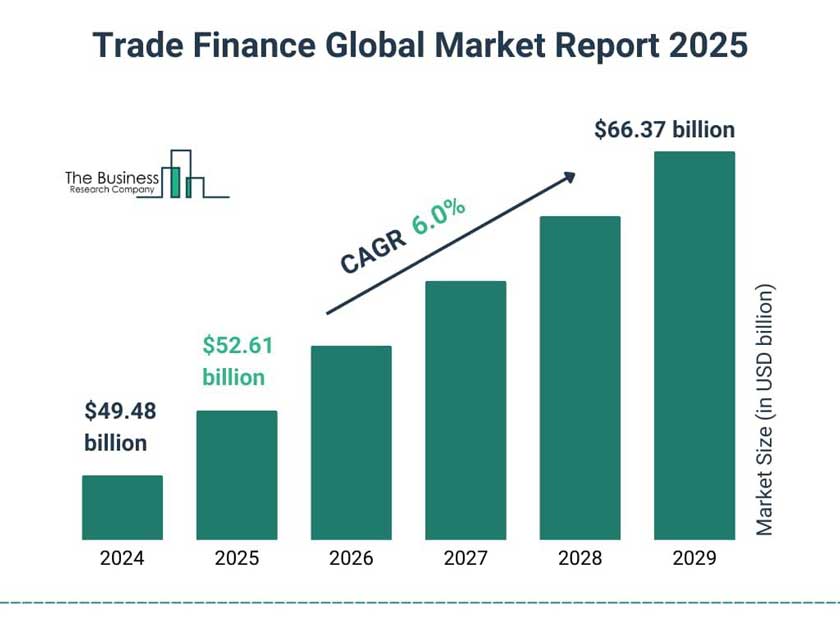
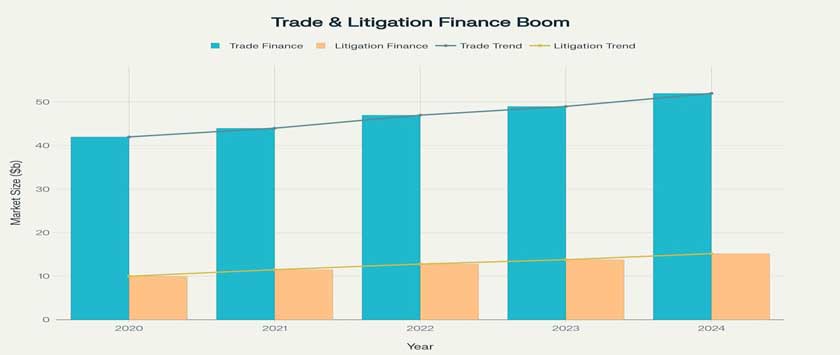
The expansion of alternative investments has extended into increasingly specialized sectors, with trade finance and litigation finance representing two of the fastest-growing segments. The global trade finance gap has expanded dramatically, reaching $2.5 trillion in 2022 from $1.7 trillion two years earlier, creating substantial opportunities for alternative capital providers. This gap reflects the withdrawal of traditional banking capital from trade finance due to increased regulatory capital requirements under Basel III.
Litigation finance has emerged as a particularly compelling alternative asset class, with the market valued at $13.84 billion in 2023 and projected to reach $25.03 billion by 2032, representing a compound annual growth rate of 6.8. This asset class offers attractive risk-adjusted returns with limited correlation to traditional financial markets. The litigation finance market has attracted increasing institutional interest due to its potential for generating consistent returns while providing diversification benefits.
From an investment perspective, trade finance represents an alternative fixed-income asset class characterized by consistent returns, low volatility, and limited correlation to traditional fixed-income markets. The sector’s appeal has been enhanced by the significant funding gap created by traditional banking sector withdrawal, creating opportunities for alternative capital providers to earn attractive risk-adjusted returns.
Historical Return Patterns and Risk Characteristics
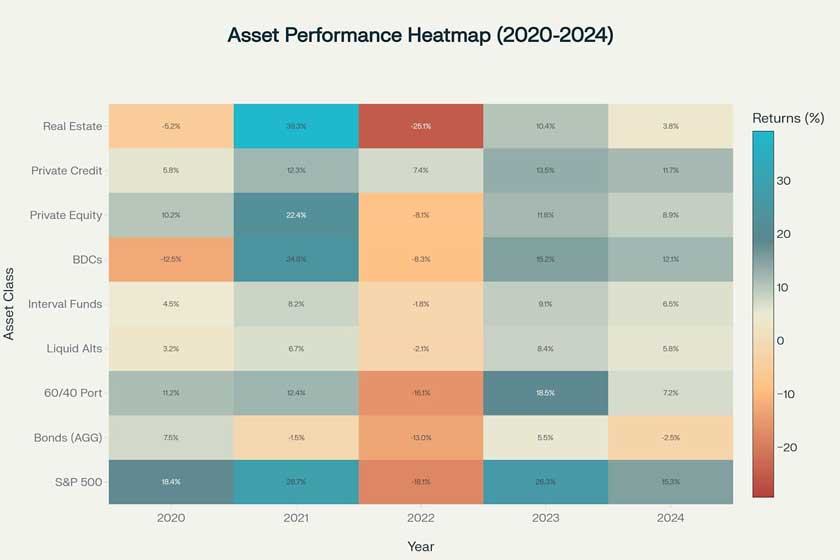
The performance differential between traditional assets and alternatives has become increasingly pronounced over the past five years, with alternative investments demonstrating both higher average returns and greater dispersion of outcomes. Alternative investments have achieved approximately 9% annual returns over the last decade, positioning them as a steady income stream with compelling value propositions for long-term investors. In comparison, the S&P 500 delivered higher average returns of about 12% annually but with significantly greater volatility and drawdown risk.
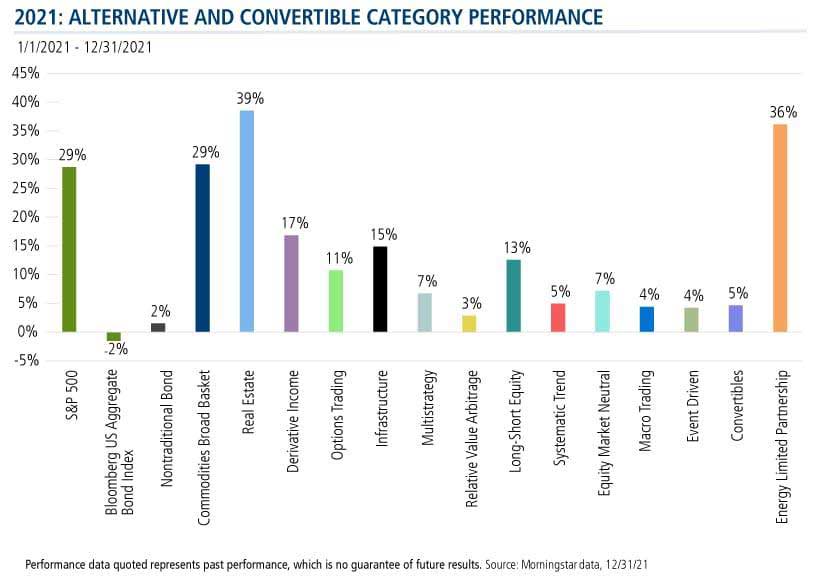
The 2021 performance data reveals the diverse return landscape across alternative investment categories, with real estate partnerships delivering exceptional returns of 39%, while energy limited partnerships achieved 36% returns during the same period. These results highlight the importance of strategy selection and timing within the alternatives universe, as performance dispersion across categories can be substantial.
Liquid alternatives have demonstrated particularly compelling performance characteristics in certain market environments, significantly outperforming traditional hedge funds in 2021 with average returns of 6.71% compared to 3.65% for unregulated hedge funds. This outperformance occurred during a challenging market environment and positioned liquid alternatives as credible substitutes for traditional bond allocations, which delivered negative returns during the same period.
Comparative Risk-Return Analysis
The risk-return profile of semi-liquid alternatives presents a compelling middle ground between traditional liquid investments and fully illiquid private market strategies. Academic research has consistently shown that hedge fund categories outperform their liquid alternative counterparts after adjusting for risk, with hedge funds demonstrating statistically significant alpha generation across most strategy categories. However, this performance advantage must be weighed against the higher fee structures and reduced liquidity access inherent in traditional hedge fund investments.
The performance dispersion within alternative investment categories underscores the critical importance of manager selection. The wide range of outcomes across managers within the same strategy category makes due diligence and ongoing monitoring essential components of successful alternative investment programs. This dispersion is particularly pronounced in hedge funds and liquid alternatives, where top-quartile managers may significantly outperform median performers.
The Institutional Shift Toward Alternatives
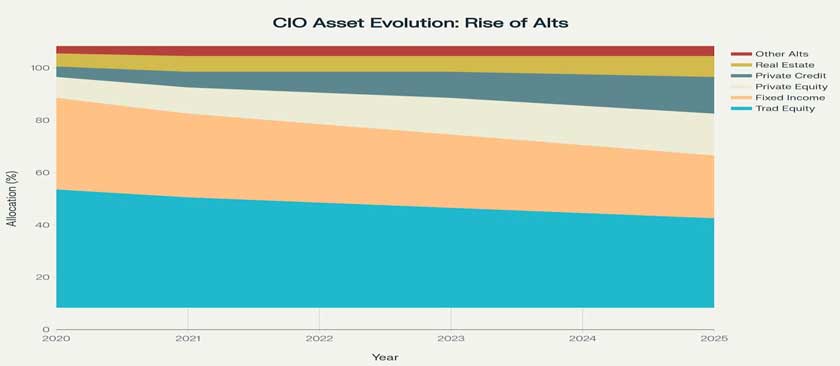
Institutional investor allocation patterns have undergone a fundamental transformation, with CIOs systematically reducing traditional asset allocations in favor of alternative investments.
The data reveals a clear trend toward increased alternative allocations, with private equity target allocations expected to increase from 15% in 2024 to 18% by 2027. Private credit represents the most dramatic shift, with target allocations projected to increase from 12% to 16% over the same period.
This reallocation comes primarily at the expense of traditional equity and fixed income allocations, which are expected to decline by 4 percentage points each by 2027. The shift reflects CIOs’ growing confidence in alternative investments’ ability to deliver superior risk-adjusted returns while providing enhanced diversification benefits. Over 90% of institutional investors now hold both private equity and private credit, representing a dramatic increase from 45% in 2021.
Future Allocation Targets and Strategic Implications
The projected allocation changes represent more than incremental adjustments; they signal a fundamental restructuring of institutional portfolio. Real estate and infrastructure allocations are also expected to increase, reflecting renewed interest in these asset classes as interest rate environments normalize. Private infrastructure and private real estate have seen the largest year-over-year increases in investor interest, with planned allocation increases rising from 35% to 50% for private infrastructure and from 24% to 37% for private real estate.
The geographic concentration of this allocation shift varies significantly, with European investors demonstrating particularly strong appetite for private real estate ]. German investors have shown the most dramatic increase in planned private real estate allocations, with interest more than doubling from the previous year. This regional variation reflects different market dynamics, regulatory environments, and institutional investor sophistication levels.
Strategic Liquidity Planning Across Investment Horizons
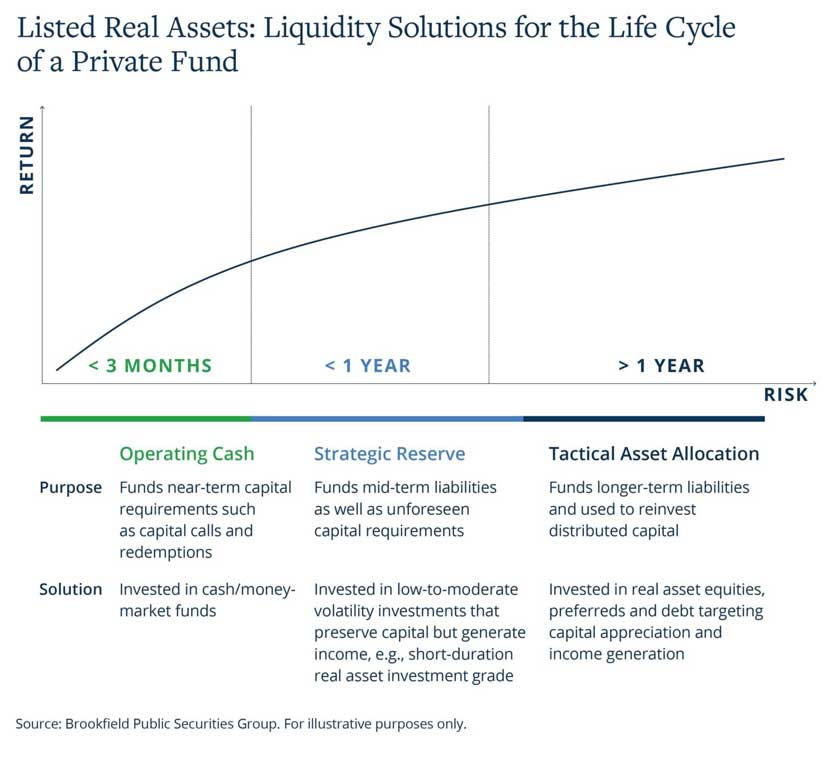
The evolution toward alternative investments has necessitated sophisticated liquidity management frameworks that accommodate varying investment time horizons and liquidity requirements. Modern CIOs must balance the enhanced return potential of illiquid alternatives with the operational liquidity needs of their institutions. This balance requires careful consideration of liquidity needs across different time horizons, from operating cash requirements under three months to tactical asset allocation decisions over periods exceeding one year.
The framework for managing liquidity within alternative investment programs has become increasingly sophisticated, incorporating elements of cash flow forecasting, stress testing, and scenario analysis. CIOs must consider not only the direct liquidity characteristics of their alternative investments but also the correlation of liquidity needs across different market environments. This comprehensive approach to liquidity management enables institutions to maximize their allocation to higher-returning illiquid alternatives while maintaining adequate operational flexibility.
Innovation in Alternative Access Mechanisms
The development of new access mechanisms for alternative investments represents a significant innovation in portfolio construction. These mechanisms include the creation of semi-liquid structures like interval funds and non-traded real estate investment trusts, the expansion of business development companies, and the growth of fund aggregators providing secondary liquidity. European markets have introduced new fund structures designed to facilitate individual investments in less liquid assets, including the UK’s Long Term Asset Fund and the EU’s revised European Long Term Investment Fund.
The technological innovation supporting these new access mechanisms has become a critical differentiator for alternative investment provider. Technology-enabled platforms offer rapid transaction processing, enhanced transparency, and improved customer experience compared to traditional alternative investment structures. These innovations have reduced the practical barriers to alternative investment access while maintaining the return characteristics that make these strategies attractive.
Market Evolution and Emerging Opportunities
The alternative investment landscape continues to evolve rapidly, with new strategies and structures emerging to meet institutional investor demands. Digital infrastructure has become a particular focus area, with 65% of investors increasing allocations to data centers driven by cloud computing and artificial intelligence demand. Energy infrastructure credit has also gained significant traction, with over 30% of investors increasing private fixed income allocations focusing on this sector.
The outlook for 2025 and beyond suggests continued growth in alternative investment allocations, though at a potentially more measured pace than the rapid expansion of recent years. The global alternative investment market is expected to continue expanding, though fundraising activity is tracking below historical levels, indicating a more selective environment for capital raising. This selectivity may favor established managers with strong track records while creating challenges for emerging managers seeking to raise capital.
Regulatory and Structural Considerations
The regulatory environment for alternative investments continues to evolve, with particular focus on enhancing transparency and investor protection while maintaining innovation. The development of new regulatory frameworks, such as those emerging in various Gulf Cooperation Council countries, reflects the global nature of alternative investment growth. These regulatory developments aim to balance investor protection with the need to facilitate continued innovation in alternative investment structures.
The long-term sustainability of current alternative investment allocation trends depends partly on the ability of these strategies to continue delivering superior risk-adjusted returns. As more capital flows into alternative investments, the return premiums that have historically justified these allocations may compress. This dynamic requires CIOs to become increasingly sophisticated in their strategy selection and manager due diligence processes.
The rise of alternative liquidity represents a fundamental transformation in how institutional investors approach portfolio construction and risk management. CIOs have successfully redefined access to alternative investments through innovative structures, sophisticated liquidity management frameworks, and strategic allocation shifts that prioritize long-term value creation. The data clearly demonstrates that this transformation is not a temporary trend but a permanent restructuring of institutional investment practices.
The future success of this alternative investment paradigm will depend on continued innovation in access mechanisms, ongoing performance differentiation relative to traditional assets, and the development of robust risk management frameworks that can accommodate the unique characteristics of alternative investments. As the alternative investment universe continues to expand and mature, CIOs who successfully navigate this evolution will be positioned to deliver superior outcomes for their stakeholders while contributing to the continued development of global capital markets.
This analysis is part of the South Sigma Insights series, providing comprehensive research and strategic analysis for business leaders and financial professionals.
South Sigma Consulting FZCO (“South Sigma”) is an independent investment research and advisory firm providing consulting services to advisory groups, family offices, and institutional investors. Our services include manager sourcing, strategy due diligence, and portfolio design, with a focus on alternative investments such as hedge funds, private markets, real assets, and infrastructure. The information provided by South Sigma is intended solely for sophisticated and professional investors and is for informational and discussion purposes only. It is not intended for retail investors or the general public. South Sigma does not provide financial product advice, nor does it offer, promote, or distribute specific investment products or securities. All research, opinions, and assessments are provided on a non-reliance basis and should not be interpreted as a recommendation to invest, hold, or divest from any particular fund, manager, or strategy. Users are solely responsible for verifying the information provided and conducting their own due diligence. Investment decisions should be made based on independent judgment and, where appropriate, in consultation with qualified financial, legal, and tax advisors. While South Sigma strives to ensure the accuracy and reliability of the information it provides, no warranty or representation is made as to its completeness, accuracy, or fitness for any particular purpose. The information is provided “as is,” and South Sigma disclaims all warranties, express or implied, including but not limited to warranties of merchantability and fitness for a particular purpose. South Sigma does not act as a fiduciary or agent for any party and accepts no liability for any loss arising directly or indirectly from the use of information provided in the course of its consulting services. The information is not a substitute for professional advice. All content is confidential and proprietary to South Sigma Consulting FZCO. It may not be reproduced, distributed, or published without prior written consent from South Sigma.
For inquiries, please contact info@southsigma.com.
Accept Cancel