

Debt Solutions
Future Scenarios
Investment Strategy
Global Impact
Policy Actions
The United States faces an unprecedented fiscal challenge as its national debt reaches historic levels, prompting critical questions about long-term sustainability and global economic stability. This comprehensive analysis examines the current debt trajectory, evaluates potential scenarios, assesses reduction strategies, and explores the far-reaching implications of America’s fiscal position on global markets and investment strategies.
Debt Trajectory and Magnitude
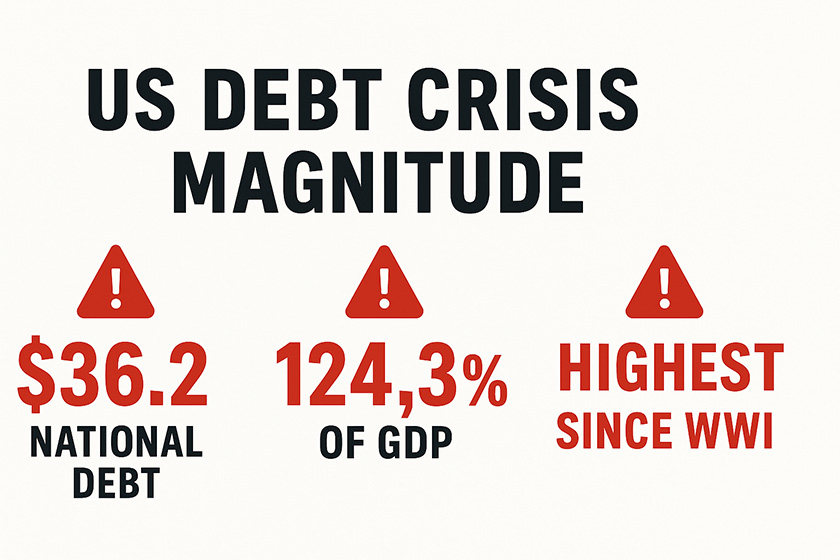
As of June 2025, the US national debt has reached $36.2 trillion, representing 124.3% of GDP—the highest debt-to-GDP ratio since World War II. The debt ceiling was automatically reinstated at $36.1 trillion on January 2, 2025, following the expiration of the Fiscal Responsibility Act suspension. Current projections indicate the Treasury will exhaust extraordinary measures and reach the X-Date between June and August 2025, requiring immediate Congressional action to prevent default.
Foreign investors hold approximately 29.5% of the total debt, down from a peak of 48% but still representing significant international exposure. The average maturity of outstanding debt has shortened to 6.2 years, increasing refinancing risk in a rising interest rate environment.
Historical Debt Evolution
The trajectory of US debt reveals distinct phases of fiscal expansion and contraction. From 1950 to 1980, debt levels remained relatively stable, with the debt-to-GDP ratio declining from 92.1% to 33.4% due to post-war economic growth.
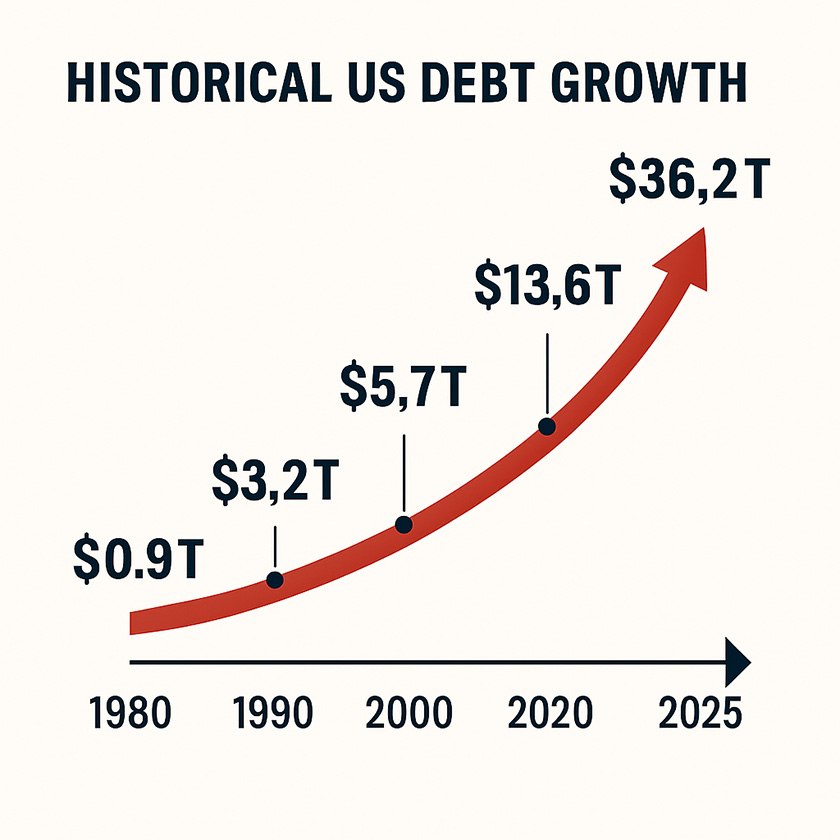
The 1980s marked a turning point, as Reagan-era policies and military expansion drove debt from $0.9 trillion to $3.2 trillion by 1990.
The 2008 financial crisis initiated another dramatic expansion, with debt nearly doubling from $10 trillion to $18.2 trillion between 2008 and 2015. The COVID-19 pandemic accelerated this trend, adding $10 trillion in just five years, bringing total debt to current levels.
Interest payments have grown exponentially, reaching $1.1 trillion annually in 2025—triple the 2010 level and representing 17.8% of the federal budget. This trend reflects both growing principal balances and rising interest rates, with the average borrowing cost increasing to 3.4%.
Current Sustainability Metrics
The sustainability of US debt depends on multiple interconnected factors, including economic growth rates, interest rates, and the government’s ability to maintain primary fiscal balances. Current analysis suggests the US requires a primary balance surplus of 1.2% of GDP to stabilize debt ratios, assuming baseline economic conditions.
The debt service coverage ratio stands at 5.2x, indicating manageable short-term obligations but declining fiscal flexibility.
Fiscal space analysis indicates the US retains 45-65% of GDP in additional borrowing capacity before reaching critical thresholds. However, this estimate assumes continued market confidence and excludes contingent liabilities exceeding $200 trillion, primarily from unfunded Social Security and Medicare obligations.
Scenario-Based Projections
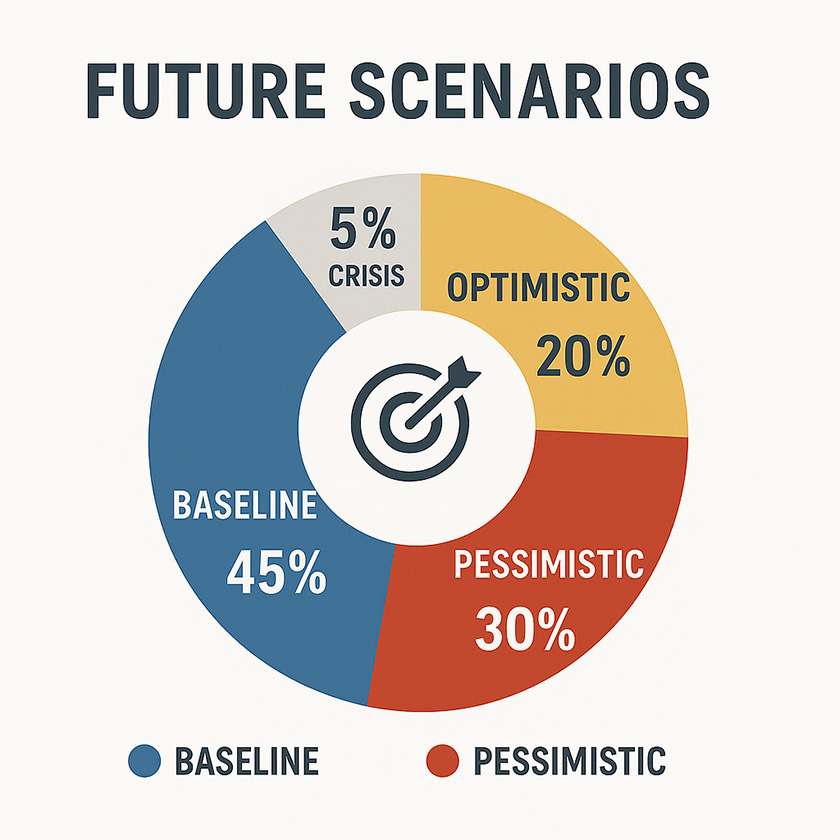
Four distinct scenarios emerge from current fiscal and economic trends, each carrying different probabilities and debt trajectories.
The baseline scenario (45% probability) projects debt reaching $42.3 trillion by 2030 and $48.9 trillion by 2035, assuming moderate 2.1% GDP growth and 4.5% average interest rates. This scenario maintains current policy frameworks without significant fiscal reforms.
The optimistic scenario (20% probability) envisions strong economic growth of 3.2% annually, coupled with fiscal consolidation measures and lower interest rates averaging 3.8%. Under these conditions, debt would reach $38.5 trillion by 2030, representing improved sustainability metrics. This scenario requires successful implementation of productivity-enhancing reforms and favorable global economic conditions.
Conversely, the pessimistic scenario (30% probability) assumes slow growth of 1.2%, higher interest rates of 5.8%, and political gridlock preventing meaningful reforms. Debt would balloon to $47.1 trillion by 2030 and $58.4 trillion by 2035, raising default risk probability to 8.5%. This scenario reflects potential outcomes from trade conflicts, infrastructure deterioration, or prolonged political dysfunction.
The crisis scenario (5% probability) models a severe economic downturn with negative 0.5% growth, 7.2% interest rates, and debt reaching $72.1 trillion by 2035. Default probability under this scenario rises to 25%, reflecting market panic and institutional breakdown.
Revenue Enhancement Measures
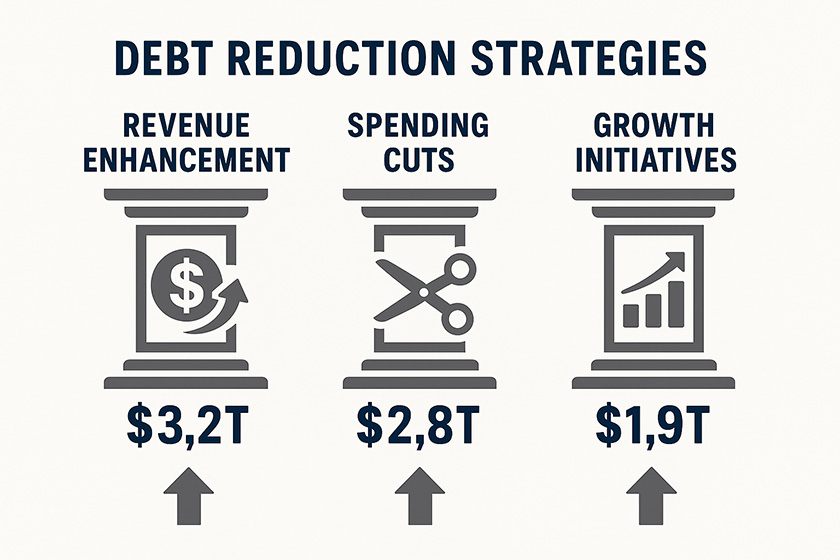
Revenue enhancement represents the largest potential source of debt reduction, offering $3.2 trillion in savings over ten years.
Key components include comprehensive tax reform, closing corporate loopholes, implementing digital service taxes, and raising rates on high-income earners. However, political feasibility remains low due to anti-tax sentiment and lobbying resistance.
The 2025 reconciliation process demonstrates these challenges, with House proposals extending Tax Cuts and Jobs Act provisions that would increase deficits by $4.3 trillion over ten years. These measures conflict with debt reduction objectives and highlight the political difficulty of implementing revenue-positive reforms.
Spending Reduction Options
Spending cuts offer $2.8 trillion in potential savings but face even greater political obstacles. Defense spending reductions, entitlement reforms, and discretionary spending caps represent the largest opportunities. Medicare provider payment reductions and Social Security benefit adjustments could generate substantial savings while maintaining program viability.
However, implementation difficulty rates as “high” and political feasibility as “very low” for most spending reduction measures. The aging population will add $58 trillion in costs by 2050 under current law, necessitating reforms regardless of political preferences.
Economic Growth Initiatives
Growth-oriented strategies offer $1.9 trillion in savings through increased tax revenues and reduced social spending. Infrastructure investment, research and development funding, and education reforms can enhance productivity and long-term growth prospects. These measures enjoy higher political feasibility due to their positive economic impact.
Monetary policy coordination presents additional opportunities, with Federal Reserve balance sheet management and yield curve control potentially reducing borrowing costs by $500 billion over ten years. Such coordination requires careful calibration to avoid inflationary pressures while supporting fiscal objectives.
Asset Allocation Framework
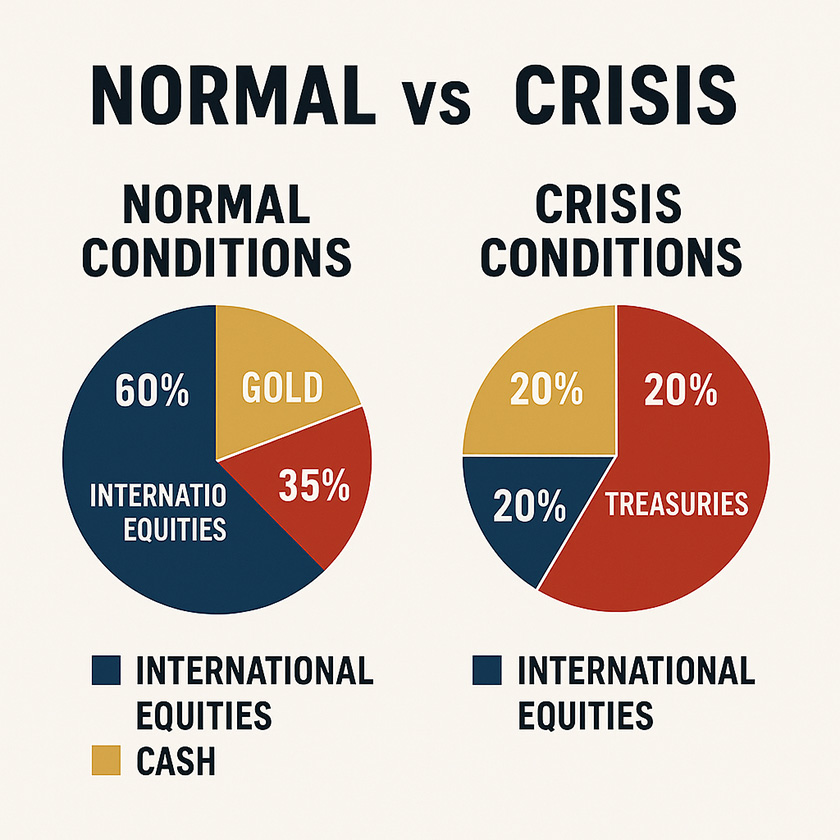
Investment strategies must adapt to evolving debt crisis probabilities and their market implications. Under normal conditions, traditional portfolio allocations favor equities (35%), long-term Treasuries (25%), and real estate (20%).
However, crisis scenarios require significant rebalancing toward defensive assets and international diversification.
During mild crisis conditions (elevated but manageable debt levels), recommended allocations shift toward short-term Treasuries (25%), international equities (20%), and gold (15%). This positioning provides liquidity while maintaining growth exposure through geographic diversification.
Severe crisis scenarios necessitate defensive positioning with short-term Treasuries (35%), gold (25%), international equities (25%), and cash positions (15%). Long-term Treasury exposure should decline to 5% due to duration risk and potential credit concerns.
Default Scenario Positioning
A US default scenario requires radical portfolio restructuring, emphasizing international assets and tangible stores of value. Optimal allocation includes international equities (35%), gold (35%), foreign government bonds (30%), and cash (20%). US Treasury exposure should approach zero, while domestic equity allocation drops to 10%.
Infrastructure assets gain prominence across all crisis scenarios, rising from 8% in normal conditions to 18% in default scenarios. These assets provide inflation protection and essential service exposure while offering geographic diversification.
Gold emerges as the premier crisis hedge, with allocations ranging from 5% in normal times to 35% in default scenarios. Historical performance during financial crises and its role as a store of value justify increased exposure as debt sustainability deteriorates.
Geographic Diversification
International diversification becomes critical as US debt concerns mount. Emerging market investment-grade sovereign debt offers attractive yields while reducing US exposure. European and Asian markets provide developed-economy alternatives with lower correlation to US fiscal outcomes.
However, investors must recognize that US default would create global contagion effects, limiting the effectiveness of geographic diversification. No asset class or geography would remain entirely insulated from a US fiscal crisis.
Regional Impact Assessment
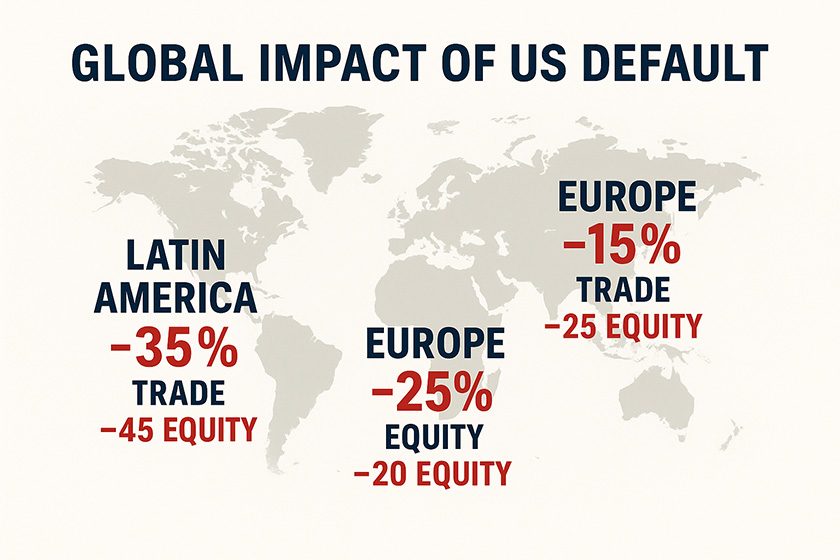
A US debt default would trigger unprecedented global economic disruption, with impacts varying significantly across regions and economies. The interconnected nature of global financial markets amplifies these effects through multiple transmission channels.
Latin America faces the most severe projected impacts, with trade declining 35%, equity markets falling 45%, and economic growth contracting 3.8%. These economies’ dependence on US trade and dollar financing creates particular vulnerability to American fiscal instability.
Sub-Saharan Africa would experience similar devastation, with 28% trade declines, 42% equity market losses, and 3.5% growth contractions. Limited fiscal space and high external debt burdens leave these economies with few policy responses to external shocks.
Emerging markets broadly face severe consequences, with 30% trade disruptions, 40% equity declines, and 3.2% growth contractions. Bond yields would spike by 300 basis points, creating debt service difficulties for highly leveraged economies.
Developed Economy Responses
Advanced economies would face significant but more manageable impacts due to stronger institutions and policy flexibility. The European Union projects 15% trade declines, 25% equity losses, and 1.8% growth contractions, while maintaining financial system stability.
Japan’s unique position as a safe haven could generate currency appreciation (+5% for JPY) despite 20% trade declines and 22% equity losses. The UK faces particular vulnerability due to financial sector exposure, projecting 28% equity declines and 2.1% growth contractions.
China’s response remains uncertain, with projected 25% trade declines and 20% equity losses. However, China’s large domestic market and policy autonomy may limit contagion effects compared to more trade-dependent economies.
Financial Market Transmission
Global bond markets would experience severe disruption, with yield increases ranging from 80 basis points in China to 400 basis points in Latin America. These increases reflect flight-to-quality flows, credit risk repricing, and liquidity constraints.
Currency markets would face extreme volatility, with most major currencies depreciating against remaining safe havens. The euro, pound, and commodity currencies would face significant pressure as risk appetite collapses.
Equity markets globally would suffer substantial losses, ranging from 20% in China to 45% in Latin America. Financial sector stocks would face particular pressure due to credit exposure and funding market disruption.
Immediate Actions Required
The approaching X-Date necessitates immediate Congressional action to raise or suspend the debt ceiling. Delays beyond August 2025 risk triggering the crisis scenarios outlined above, with cascading global consequences. Extraordinary measures provide limited time for political negotiations but cannot prevent eventual default without legislative intervention.
Fiscal consolidation measures should accompany debt ceiling resolution to address underlying sustainability concerns. A comprehensive package combining revenue increases, spending reforms, and growth initiatives could reduce deficit projections by $6-8 trillion over ten years.
Structural Reforms
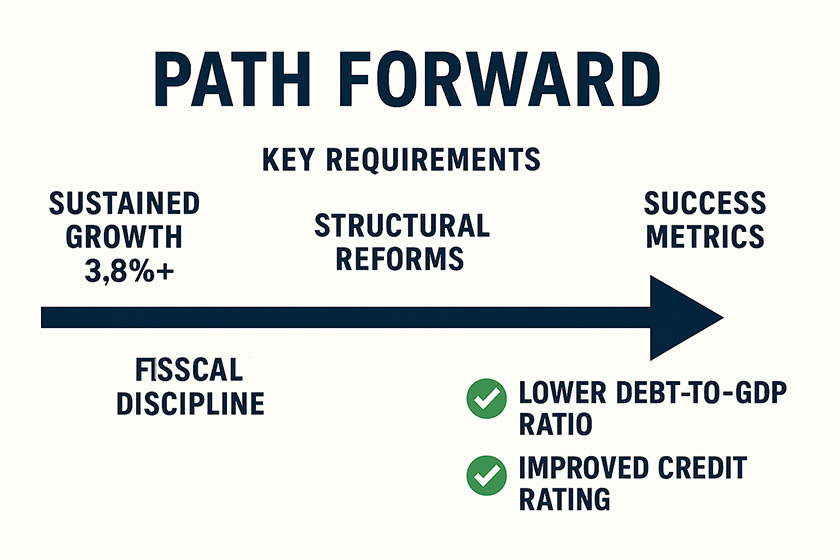
Long-term debt sustainability requires fundamental reforms to address demographic transitions and contingent liabilities. Social Security and Medicare reforms become unavoidable as unfunded obligations reach $200+ trillion. Gradual implementation starting in 2026 could significantly improve long-term fiscal projections.
Infrastructure investment and productivity enhancement offer paths to sustained higher growth rates necessary for debt sustainability. Annual GDP growth of 3.8% or higher would stabilize debt ratios without requiring severe fiscal adjustment.
International Cooperation
Global cooperation becomes essential given the interconnected nature of modern financial markets. International monetary coordination could help manage crisis impacts and maintain global financial stability. Dollar swap arrangements and multilateral lending facilities would provide crucial liquidity during transition periods.
The United States faces a critical juncture in its fiscal history, with national debt reaching levels that challenge long-term sustainability and threaten global economic stability. Current debt dynamics, characterized by accelerating growth and rising interest costs, demand immediate attention and comprehensive policy responses.
The analysis reveals four distinct scenarios for America’s fiscal future, ranging from manageable adjustment under optimistic conditions to crisis-driven default with devastating global consequences. The baseline scenario suggests debt will continue growing faster than the economy without significant policy intervention, eventually triggering sustainability concerns.
Successful debt reduction requires a comprehensive approach combining revenue enhancement, spending reforms, and growth initiatives. However, political constraints significantly limit implementation possibilities, particularly for measures with the largest potential impact. The window for gradual adjustment narrows with each passing year of inaction.
Investment strategies must acknowledge the growing probability of US fiscal stress and position accordingly. International diversification, defensive asset allocation, and crisis hedges become increasingly important as debt sustainability deteriorates. No investment strategy can fully protect against US default, but appropriate positioning can mitigate risks.
The global implications of US fiscal instability extend far beyond American borders, threatening the international monetary system and global economic growth. Early action to address debt sustainability serves not only American interests but global financial stability.
The path forward requires unprecedented political will, international cooperation, and comprehensive reform of fiscal institutions. The alternative—continuing on the current trajectory—risks triggering the most severe global financial crisis since the Great Depression. The choice facing American policymakers extends beyond domestic politics to the fundamental architecture of the global economy.
This analysis is part of the South Sigma Insights series, providing comprehensive research and strategic analysis for business leaders and financial professionals.
South Sigma Consulting FZCO (“South Sigma”) is an independent investment research and advisory firm providing consulting services to advisory groups, family offices, and institutional investors. Our services include manager sourcing, strategy due diligence, and portfolio design, with a focus on alternative investments such as hedge funds, private markets, real assets, and infrastructure. The information provided by South Sigma is intended solely for sophisticated and professional investors and is for informational and discussion purposes only. It is not intended for retail investors or the general public. South Sigma does not provide financial product advice, nor does it offer, promote, or distribute specific investment products or securities. All research, opinions, and assessments are provided on a non-reliance basis and should not be interpreted as a recommendation to invest, hold, or divest from any particular fund, manager, or strategy. Users are solely responsible for verifying the information provided and conducting their own due diligence. Investment decisions should be made based on independent judgment and, where appropriate, in consultation with qualified financial, legal, and tax advisors. While South Sigma strives to ensure the accuracy and reliability of the information it provides, no warranty or representation is made as to its completeness, accuracy, or fitness for any particular purpose. The information is provided “as is,” and South Sigma disclaims all warranties, express or implied, including but not limited to warranties of merchantability and fitness for a particular purpose. South Sigma does not act as a fiduciary or agent for any party and accepts no liability for any loss arising directly or indirectly from the use of information provided in the course of its consulting services. The information is not a substitute for professional advice. All content is confidential and proprietary to South Sigma Consulting FZCO. It may not be reproduced, distributed, or published without prior written consent from South Sigma.
For inquiries, please contact info@southsigma.com.
Accept Cancel